

Pass Your CIPS Level 6 Professional Diploma L6M9 Exam on Feb 19, 2026 with 86 Questions
L6M9 Free Exam Study Guide! (Updated 86 Questions)
CIPS L6M9 Exam Syllabus Topics:
| Topic | Details |
|---|---|
| Topic 1 |
|
| Topic 2 |
|
| Topic 3 |
|
NEW QUESTION # 23
When would an organisation use aVRIO analysis?
- A. To benchmark the organisation against similar organisations in the market
- B. To identify internal resources that provide competitive advantage
- C. To monitor performance of the operations department against predetermined criteria
- D. To create a vision and mission statement for the organisation
Answer: B
Explanation:
* VRIO analysishelps an organisationidentify internal resourcesthat give it acompetitive advantage.
* VRIO stands forValue, Rarity, Imitability, Organisation-factors that determine whether a resource can sustain a competitive edge.
* Itdoes notfocus on benchmarking (C) or performance monitoring (B).
(LO 2.2, See p.103)
NEW QUESTION # 24
Jed is theOperations Managerat acake manufacturerand is trying to determine theoptimumcapacityof the factory.
Which of the following would be true if the factoryachieves optimum capacity? SelectALLthat apply.
- A. The factory breaks even
- B. The highest cost per item is achieved
- C. The lowest total cost for production is achieved
- D. The factory fulfills customer demand for items
- E. The factory physically cannot produce more items
- F. Inventory levels are maximized
Answer: C,D
Explanation:
Optimum capacityis achieved when:
* Customer demand is met (B)
* Production costs are minimized (C)
#Incorrect options:
* (A)is false because optimum capacityisn't necessarily the physical limit
* (D)is false because the factory should beoperating at a profit, not breakeven
* (E)is false because the lowest cost per unit is achieved, not the highest
* (F)is false becauseinventory levels should be minimized, not maximized (to reduce storage costs) (See LO 1.3, p.46)
NEW QUESTION # 25
Scenario:
Blue Bear Ltd is amultifunctional manufacturing organisationwith aglobal supply chainand customers in over30 different countries. Each function within the company hasdifferent supplynetworksand relationships.
For eachfunction, select the correctValue Chain ActivityandSupply Network Typefrom the given options.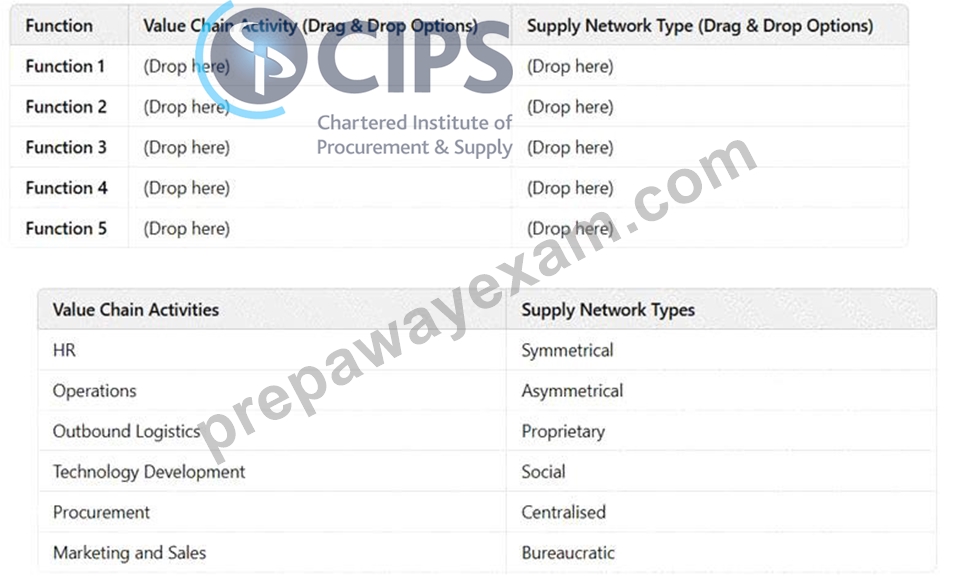
Answer:
Explanation: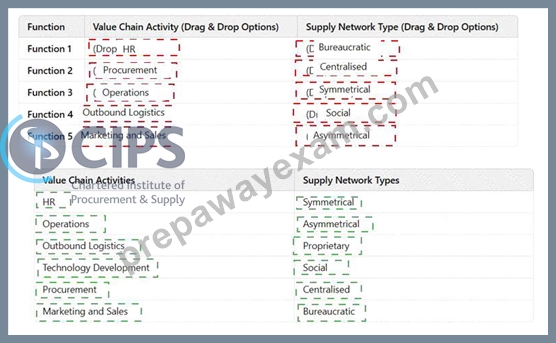
Explanation:
A white and black list with black text AI-generated content may be incorrect.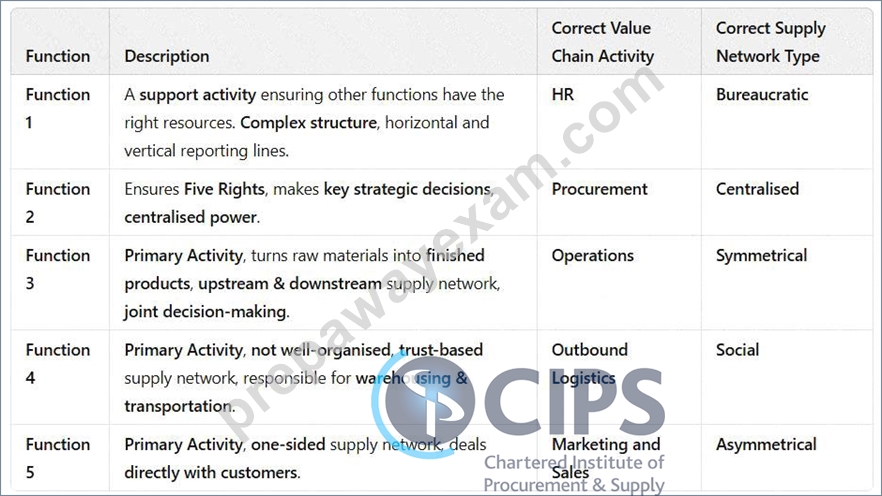
NEW QUESTION # 26
In a bottom-up process for planning and control, who would make the strategic plan?
- A. Middle managers
- B. Stakeholders
- C. Senior managers
- D. Operational staff
Answer: D
Explanation:
Operational staff would make the plan and pass this up to senior managers for approval. This is the opposite of a top-down approach, where senior managers make the plan and tell the operational staff what to do. (See p.
187)
NEW QUESTION # 27
When designing a supply network, which of the following stages should be completedfirst?
- A. Determine the approach for managing material flow
- B. Analyse potential risks
- C. Confirm the network scope
- D. Track information flow
Answer: C
Explanation:
The correct sequence fordesigning a supply networkis:
* Determine strategic objectives
* Confirm the network scope
* Analyse potential risks
* Determine the approach for managing material and information flow
* Track material and information flow
Sincenetwork scopedefines theboundaries, scale, and overall structureof the network, it must be confirmed first. (LO 1.1, See p.3)
NEW QUESTION # 28
LTL Ltd is a manufacturing organisation producing made-to-order equipment for the construction industry, such as bespoke windows and doors. The Head of Operations has received four large orders and is considering the sequencing of production. Which of the following should the company do?
- A. Use a First Come, First Serve system to prioritise the orders that were made first, ensuring customer satisfaction
- B. Start manufacturing the order that has the longest completion time first so all orders are ready at the same time
- C. Create the orders in the most logical, economic, and fastest pattern. This may mean that the first order received is the last to be produced
- D. Sequence the orders in the way that will be the cheapest to produce, creating the highest profit margin
Answer: C
Explanation:
Sequencinginvolves balancinglogic, cost, and speedto optimise production. Prioritising orders purely by arrival time (Option A) or cost efficiency (Option B) might not be practical. Similarly, making sure all orders finish at the same time (Option D) isn't always necessary. (See p.183)
NEW QUESTION # 29
The operations department of ABC Ltd has recently launched a new product. The product is manufactured within a large factory and then sent to retailers for sale. The department has a system in place which details the components required for the product and the quantities required to fulfil customer demand. The system works online and links to other areas of the business including HR and finance.
So far, several large orders have been placed for the product from different retailers. The Chief Operations Officer (COO) has decided to programme the completion of the orders based on when the orders were placed.
The benefit of this strategy is that it will give each customer a similar lead time. Thus far no buffer stock has been created as products are only created when orders are received.
Three teams are required to make the product and the product flows from team one to team two to team three, each team adding a component to the product. Unfortunately, team two are short staffed and are completing their work at a slower rate than the other two teams. This is a huge consideration for the COO as it will impact upon the capacity of the organisation.
The retailers have all signed contracts with ABC Ltd and the COO is extremely happy that they are long term contracts. Contract 1 is with retailer X and the price is set for three years. Contract 2 is with retailer Y and is a five year contract where the price will be reviewed annually in line with CPI. Contract 3 has a variable pricing mechanism based on the volume of products ordered.
What production method is used by ABC?
- A. Earliest due date
- B. Shortest processing time
- C. First in, first out
- D. Similar process
Answer: C
Explanation:
The production method isFirst In, First Out (FIFO)because orders are processed based on when they were received. This method ensures fairness in lead times across different customers. (See LO 3.2)
NEW QUESTION # 30
Maxi Ltd is a medium-sized manufacturing organisation in the automotive industry that creates engines for cars. It has traditionally worked well with its suppliers, with strong relationships and regular meetings. There are currently around 15 suppliers who provide parts to Maxi Ltd.
Due to changing customer demands, Maxi Ltd will, from next month, modify the manufacturing of some of its products. Product X is being made more environmentally friendly, with output of CO2 being reduced by 32%. The product will take longer to produce, but there will be no additional cost to customers for this.
Maxi ltd are considering outsourcing the manufacturing of Product Y as it is not a product which is routinely ordered by customers. This will allow Maxi Ltd to focus on other products which generate higher revenues for the company. The concern within the Board of Directors is that if demand increases for this product, an outsourced company may not be able to cope with higher numbers of orders.
Product Z is an extremely popular item and oftentimes Maxi Ltd does not have the capacity to fulfil all orders. Consideration has been given to increasing the size of the factory, but this has been discarded as risky as demand is not guaranteed. The product has been available on the marketplace for a short amount of time and sales are continuing to increase, but the company believes this will soon plateau. To deal with current demand, the marketing team is working on campaigns to invite customers to make orders for this product at certain times of the year when product X is not being created in the factory.
This means resources can be reallocated to the creation of product Z.
What type of supply chain does Maxi Ltd currently have?
- A. Bureaucratic
- B. Centralised
- C. Asymmetrical
- D. Symmetric
Answer: D
Explanation:
Maxi Ltd hasstrong relationships with its suppliersand holdsregular meetings, indicating asymmetric supply chain. In a symmetric supply chain, both buyers and suppliers collaborate effectively and share a balanced relationship. (LO 1.1)
NEW QUESTION # 31
What does a forcefield diagram show?
- A. The flow of information through a supply network
- B. People in favour of change and against it
- C. The sequencing of events within an operational strategy
- D. The potential causes of an issue that has occurred
Answer: B
NEW QUESTION # 32
The operations department of ABC Ltd has recently launched a new product. The product is manufactured within a large factory and then sent to retailers for sale. The department has a system in place which details the components required for the product and the quantities required to fulfil customer demand. The system works online and links to other areas of the business including HR and finance.
So far, several large orders have been placed for the product from different retailers. The Chief Operations Officer (COO) has decided to programme the completion of the orders based on when the orders were placed.
The benefit of this strategy is that it will give each customer a similar lead time. Thus far no buffer stock has been created as products are only created when orders are received.
Three teams are required to make the product and the product flows from team one to team two to team three, each team adding a component to the product. Unfortunately, team two are short staffed and are completing their work at a slower rate than the other two teams. This is a huge consideration for the COO as it will impact upon the capacity of the organisation.
The retailers have all signed contracts with ABC Ltd and the COO is extremely happy that they are long term contracts. Contract 1 is with retailer X and the price is set for three years. Contract 2 is with retailer Y and is a five year contract where the price will be reviewed annually in line with CPI. Contract 3 has a variable pricing mechanism based on the volume of products ordered.
What pricing mechanism is being used with supplier Y?
- A. Fixed price
- B. Indexation
- C. Variable price
- D. Gain share
Answer: B
Explanation:
Indexationis the correct pricing mechanism because the price is adjusted based onCPI (Consumer Price Index), which is a form of indexed pricing. This ensures that prices fluctuate in response to inflation or other economic indicators. (See LO 3.3)
NEW QUESTION # 33
What is the purpose ofsupplier development?
- A. To add value to the supply chain
- B. To ensure that there are no logistics or delivery issues within the supply chain
- C. To lower prices, which will increase the profit margin
- D. To reduce the number of suppliers upon which a business would become dependent
Answer: A
Explanation:
The primary goal ofsupplier developmentis toadd valueto the supply chain, not just to reduce costs.
* Option A is incorrectbecause supplier development is not solely about cost reduction-it also focuses onquality and efficiency.
* Option B is incorrectbecause reducing suppliers is not always the goal; sometimes businesses want a widersupplier base.
* Option D is incorrectbecause no system caneliminatelogistics risks entirely-there will always be uncertainties.
(See LO 1.1, p.2)
NEW QUESTION # 34
A car manufacturing organisation organises formal, regular meetings with itstier one suppliersfor the purpose of collaborating on improvements and changes to the final product. What is this arrangement known as?
- A. Supplier association
- B. Supplier focus group
- C. Supplier forum
- D. Supplier improvement project
Answer: A
Explanation:
This is asupplier association-the key clue in the question is "formal, regular meetings."
* Asupplier improvement projectwould be aone-offinitiative rather than ongoing formal meetings.
* Asupplier forumismore informalthan what is described in the question.
* Asupplier focus groupmeets to discuss specific topics rather than engaging in regular collaboration on improvements.
(See p.191)
NEW QUESTION # 35
Alexandra is the new Chief Procurement Officer at Wet Lettuce Incorporated, a manufacturing organisation that uses a tiered supply structure. She has asked to see the contracts with all thesuppliers and has been told that it is not common practice to have contracts with the full range of suppliers. What should Alexandra do?
- A. Set up meetings with the tier-one suppliers and assess the contracts with these suppliers
- B. Do nothing-if it is not common practice within the organisation, she should not change things
- C. Ensure contracts are immediately put in place with all suppliers within the tiered supply structure
- D. Amend the supply structure so that contracts are put in place with all suppliers
Answer: A
Explanation:
SinceWet Lettuce Incorporatedoperates atiered supply structure, it is common for contracts to be in place only with tier-one suppliers, while sub-contractors in lower tiers are managed by those suppliers. Instead of changing the entire structure, Alexandra should ensure that contracts and relationships withtier-one suppliers are well managed. (See p.195)
NEW QUESTION # 36
In amanufacturing organisationthat produces cupcakes, which of the following categories ofcapacitytakes into accountstaff absencesandunplanned lossessuch as a late delivery of raw materials?
- A. Effective capacity
- B. Available capacity
- C. Design capacity
- D. Actual capacity
Answer: D
Explanation:
* Actual capacityaccounts forreal-life factors, includingstaff absences, supply chain delays, and other disruptions.
* Design capacity (A)is themaximumproduction level in an ideal scenario (no disruptions).
* Effective capacity (B) and available capacity (C) are the same, accounting forplanned stoppages, butnot unplanned losses.
(LO 2.2, See p.115)
NEW QUESTION # 37
What does a forcefield diagram show?
- A. The flow of information through a supply network
- B. People in favour of change and against it
- C. The sequencing of events within an operational strategy
- D. The potential causes of an issue that has occurred
Answer: B
Explanation:
Aforcefield diagramidentifies forces (e.g., people or factors) that support or oppose change. This model, developed byKurt Lewin, helps organisations assess and manage resistance to change. (See p.196)
NEW QUESTION # 38
Dev is creating anOperations Strategyfor hishealthcare consultancybusiness. Which of the following describes anOperations Strategy? SelectALLthat apply.
- A. The Operations Strategy is aligned with the Organisational Strategy
- B. Operations Strategy focuses on external processes
- C. Operations Strategy is a short-ranged plan
- D. Operations Strategy supports the competitive advantage of the company
Answer: A,D
Explanation:
* Option B is correctbecause Operations Strategy helps build acompetitive advantagefor the organisation.
* Option C is correctbecause Operations Strategy must align with theoverall organisational goals.
* Option A is incorrect-it isSupply Chain Managementthat focuses onexternalprocesses.
* Option D is incorrectbecauseOperations Strategy is long-term, not short-ranged.
(See LO 2.1, p.63)
NEW QUESTION # 39
What is the purpose ofsupplier development?
- A. To add value to the supply chain
- B. To ensure that there are no logistics or delivery issues within the supply chain
- C. To lower prices, which will increase the profit margin
- D. To reduce the number of suppliers upon which a business would become dependent
Answer: A
Explanation:
The primary goal ofsupplier developmentis toadd valueto the supply chain, not just to reduce costs.
* Option A is incorrectbecause supplier development is not solely about cost reduction-it also focuses onquality and efficiency.
* Option B is incorrectbecause reducing suppliers is not always the goal; sometimes businesses want a widersupplier base.
* Option D is incorrectbecause no system caneliminatelogistics risks entirely-there will always be uncertainties.
(See LO 1.1, p.2)
NEW QUESTION # 40
Maxi Ltd is a medium-sized manufacturing organisation in the automotive industry that creates engines for cars. It has traditionally worked well with its suppliers, with strong relationships and regular meetings. There are currently around 15 suppliers who provide parts to Maxi Ltd.
Due to changing customer demands, Maxi Ltd will, from next month, modify the manufacturing of some of its products. Product X is being made more environmentally friendly, with output of CO2 being reduced by 32%. The product will take longer to produce, but there will be no additional cost to customers for this.
Maxi ltd are considering outsourcing the manufacturing of Product Y as it is not a product which is routinely ordered by customers. This will allow Maxi Ltd to focus on other products which generate higher revenues for the company. The concern within the Board of Directors is that if demand increases for this product, an outsourced company may not be able to cope with higher numbers of orders.
Product Z is an extremely popular item and oftentimes Maxi Ltd does not have the capacity to fulfil all orders. Consideration has been given to increasing the size of the factory, but this has been discarded as risky as demand is not guaranteed. The product has been available on the marketplace for a short amount of time and sales are continuing to increase, but the company believes this will soon plateau. To deal with current demand, the marketing team is working on campaigns to invite customers to make orders for this product at certain times of the year when product X is not being created in the factory.
This means resources can be reallocated to the creation of product Z.
Which of the following is thetrade-offin the modification of product X?
- A. Speed
- B. Quality
- C. Environment
- D. Flexibility
Answer: A
Explanation:
The modification ofproduct Xis aimed at making itmore environmentally friendlybut results ina longer production time. This means that thetrade-offisspeed-production takes longer. (LO 1.2)
NEW QUESTION # 41
Dan is an Operations Manager at a retail organisation. He is keen to understand more about the types of customers his organisation serves and has therefore devised new KPIs (key performance Indicators) with a customer-centric focus. He is particularly keen to understand which customersegments are providing the organisation with the highest ROI (return on investment). Which customer-centric performance measure should Dan look to introduce?
- A. Churn Rate
- B. Customer Retention Rate
- C. Customer Lifetime Value
- D. Net Promoter Score
Answer: C
Explanation:
#Customer Lifetime Value (CLV)measures the total amount a customer is expected to spend over their lifetime with a company, helping identify themost profitable customer segments.
#Other KPIs are not suitable for Dan's needs:
* Churn Rate: Measurescustomer lossover time.
* Net Promoter Score: Measurescustomer satisfaction and loyalty.
* Customer Retention Rate: Focuses onhow many customers stay with the companybut does not indicate ROI.
For more insights onCLV, visit:#Customer Lifetime Value - WallStreetMojo (See LO 2.2, p.97)
NEW QUESTION # 42
......
L6M9 Dumps for CIPS Level 6 Professional Diploma Certified Exam Questions and Answer: https://itcertspass.prepawayexam.com/CIPS/braindumps.L6M9.ete.file.html