

Exam Associate-Developer-Apache-Spark-3.5 Realistic Dumps Verified Questions Free [Nov 21, 2025]
Valid Associate-Developer-Apache-Spark-3.5 Dumps for Helping Passing Databricks Exam!
NEW QUESTION # 42
What is a feature of Spark Connect?
- A. Supports DataFrame, Functions, Column, SparkContext PySpark APIs
- B. It supports only PySpark applications
- C. It has built-in authentication
- D. It supports DataStreamReader, DataStreamWriter, StreamingQuery, and Streaming APIs
Answer: D
Explanation:
Comprehensive and Detailed Explanation From Exact Extract:
Spark Connect is a client-server architecture introduced in Apache Spark 3.4, designed to decouple the client from the Spark driver, enabling remote connectivity to Spark clusters.
According to the Spark 3.5.5 documentation:
"Majority of the Streaming API is supported, including DataStreamReader, DataStreamWriter, StreamingQuery and StreamingQueryListener." This indicates that Spark Connect supports key components of Structured Streaming, allowing for robust streaming data processing capabilities.
Regarding other options:
B).While Spark Connect supports DataFrame, Functions, and Column APIs, it does not support SparkContext and RDD APIs.
C).Spark Connect supports multiple languages, including PySpark and Scala, not just PySpark.
D).Spark Connect does not have built-in authentication but is designed to work seamlessly with existing authentication infrastructures.
NEW QUESTION # 43
Given a CSV file with the content: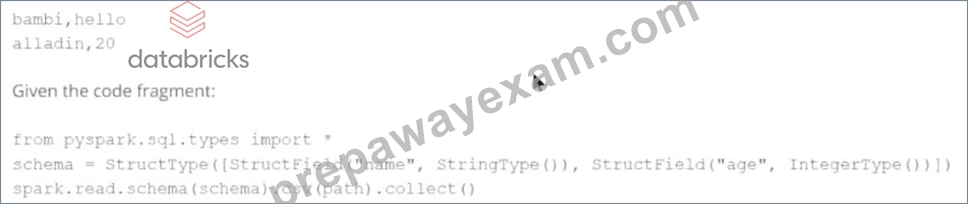
And the following code:
from pyspark.sql.types import *
schema = StructType([
StructField("name", StringType()),
StructField("age", IntegerType())
])
spark.read.schema(schema).csv(path).collect()
What is the resulting output?
- A. [Row(name='bambi', age=None), Row(name='alladin', age=20)]
- B. [Row(name='bambi'), Row(name='alladin', age=20)]
- C. The code throws an error due to a schema mismatch.
- D. [Row(name='alladin', age=20)]
Answer: A
Explanation:
Comprehensive and Detailed Explanation From Exact Extract:
In Spark, when a CSV row does not match the provided schema, Spark does not raise an error by default.
Instead, it returnsnullfor fields that cannot be parsed correctly.
In the first row,"hello"cannot be cast to Integer for theagefield # Spark setsage=None In the second row,"20"is a valid integer #age=20 So the output will be:
[Row(name='bambi', age=None), Row(name='alladin', age=20)]
Final Answer: C
NEW QUESTION # 44
Given this view definition:
df.createOrReplaceTempView("users_vw")
Which approach can be used to query the users_vw view after the session is terminated?
Options:
- A. Save the users_vw definition and query using Spark
- B. Query the users_vw using Spark
- C. Recreate the users_vw and query the data using Spark
- D. Persist the users_vw data as a table
Answer: D
Explanation:
Temp views likecreateOrReplaceTempVieware session-scoped.
They disappear once the Spark session ends.
To retain data across sessions, it must be persisted:
df.write.saveAsTable("users_vw")
Thus, the view needs to be persisted as a table to survive session termination.
Reference:Databricks - Temp vs Global vs Permanent Views
NEW QUESTION # 45
A data scientist of an e-commerce company is working with user data obtained from its subscriber database and has stored the data in a DataFrame df_user. Before further processing the data, the data scientist wants to create another DataFrame df_user_non_pii and store only the non-PII columns in this DataFrame. The PII columns in df_user are first_name, last_name, email, and birthdate.
Which code snippet can be used to meet this requirement?
- A. df_user_non_pii = df_user.drop("first_name", "last_name", "email", "birthdate")
- B. df_user_non_pii = df_user.dropfields("first_name, last_name, email, birthdate")
- C. df_user_non_pii = df_user.drop("first_name", "last_name", "email", "birthdate")
- D. df_user_non_pii = df_user.dropfields("first_name", "last_name", "email", "birthdate")
Answer: C
Explanation:
Comprehensive and Detailed Explanation:
To remove specific columns from a PySpark DataFrame, the drop() method is used. This method returns a new DataFrame without the specified columns. The correct syntax for dropping multiple columns is to pass each column name as a separate argument to the drop() method.
Correct Usage:
df_user_non_pii = df_user.drop("first_name", "last_name", "email", "birthdate") This line of code will return a new DataFrame df_user_non_pii that excludes the specified PII columns.
Explanation of Options:
A).Correct. Uses the drop() method with multiple column names passed as separate arguments, which is the standard and correct usage in PySpark.
B).Although it appears similar to Option A, if the column names are not enclosed in quotes or if there's a syntax error (e.g., missing quotes or incorrect variable names), it would result in an error. However, as written, it's identical to Option A and thus also correct.
C).Incorrect. The dropfields() method is not a method of the DataFrame class in PySpark. It's used with StructType columns to drop fields from nested structures, not top-level DataFrame columns.
D).Incorrect. Passing a single string with comma-separated column names to dropfields() is not valid syntax in PySpark.
References:
PySpark Documentation:DataFrame.drop
Stack Overflow Discussion:How to delete columns in PySpark DataFrame
NEW QUESTION # 46
A data scientist is working on a large dataset in Apache Spark using PySpark. The data scientist has a DataFramedfwith columnsuser_id,product_id, andpurchase_amountand needs to perform some operations on this data efficiently.
Which sequence of operations results in transformations that require a shuffle followed by transformations that do not?
- A. df.withColumn("purchase_date", current_date()).where("total_purchase > 50")
- B. df.withColumn("discount", df.purchase_amount * 0.1).select("discount")
- C. df.groupBy("user_id").agg(sum("purchase_amount").alias("total_purchase")).repartition(10)
- D. df.filter(df.purchase_amount > 100).groupBy("user_id").sum("purchase_amount")
Answer: C
Explanation:
Comprehensive and Detailed Explanation From Exact Extract:
Shuffling occurs in operations likegroupBy,reduceByKey, orjoin-which cause data to be moved across partitions. Therepartition()operation can also cause a shuffle, but in this context, it follows an aggregation.
InOption D, thegroupByfollowed byaggresults in a shuffle due to grouping across nodes.
Therepartition(10)is a partitioning transformation but does not involve a new shuffle since the data is already grouped.
This sequence - shuffle (groupBy) followed by non-shuffling (repartition) - is correct.
Option A does the opposite: thefilterdoes not cause a shuffle, butgroupBydoes - this makes it the wrong order.
NEW QUESTION # 47
A data engineer wants to create a Streaming DataFrame that reads from a Kafka topic called feed.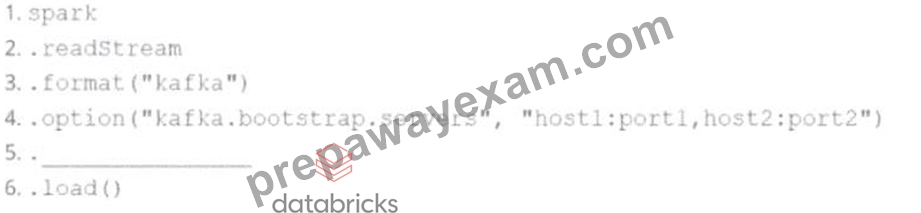
Which code fragment should be inserted in line 5 to meet the requirement?
Code context:
spark \
.readStream \
.format("kafka") \
.option("kafka.bootstrap.servers","host1:port1,host2:port2") \
.[LINE5] \
.load()
Options:
- A. .option("kafka.topic", "feed")
- B. .option("topic", "feed")
- C. .option("subscribe", "feed")
- D. .option("subscribe.topic", "feed")
Answer: C
Explanation:
Comprehensive and Detailed Explanation:
To read from a specific Kafka topic using Structured Streaming, the correct syntax is:
python
CopyEdit
option("subscribe","feed")
This is explicitly defined in the Spark documentation:
"subscribe - The Kafka topic to subscribe to. Only one topic can be specified for this option." (Source:Apache Spark Structured Streaming + Kafka Integration Guide)
B)."subscribe.topic" is invalid.
C)."kafka.topic" is not a recognized option.
D)."topic" is not valid for Kafka source in Spark.
NEW QUESTION # 48
A data engineer is working ona Streaming DataFrame streaming_df with the given streaming data: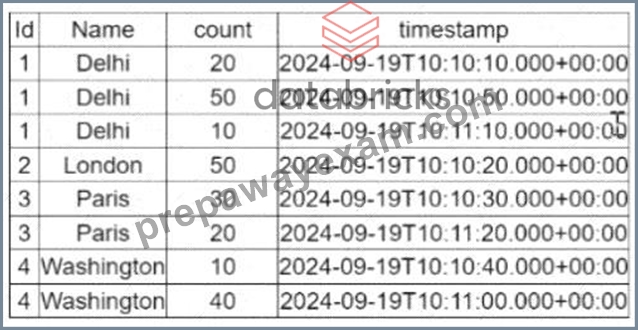
Which operation is supported with streaming_df?
- A. streaming_df.filter(col("count") < 30).show()
- B. streaming_df.select(countDistinct("Name"))
- C. streaming_df.groupby("Id").count()
- D. streaming_df.orderBy("timestamp").limit(4)
Answer: C
Explanation:
Comprehensive and Detailed
Explanation:
In Structured Streaming, only a limited subset of operations is supported due to the nature of unbounded data.
Operations like sorting (orderBy) and global aggregation (countDistinct) require a full view of the dataset, which is not possible with streaming data unless specific watermarks or windows are defined.
Review of Each Option:
A). select(countDistinct("Name"))
Not allowed - Global aggregation like countDistinct() requires the full dataset and is not supported directly in streaming without watermark and windowing logic.
Reference: Databricks Structured Streaming Guide - Unsupported Operations.
B). groupby("Id").count()Supported - Streaming aggregations over a key (like groupBy("Id")) are supported.
Spark maintains intermediate state for each key.Reference: Databricks Docs # Aggregations in Structured Streaming (https://docs.databricks.com/structured-streaming/aggregation.html)
C). orderBy("timestamp").limit(4)Not allowed - Sorting and limiting require a full view of the stream (which is infinite), so this is unsupported in streaming DataFrames.Reference: Spark Structured Streaming - Unsupported Operations (ordering without watermark/window not allowed).
D). filter(col("count") < 30).show()Not allowed - show() is a blocking operation used for debugging batch DataFrames; it's not allowed on streaming DataFrames.Reference: Structured Streaming Programming Guide
- Output operations like show() are not supported.
Reference Extract from Official Guide:
"Operations like orderBy, limit, show, and countDistinct are not supported in Structured Streaming because they require the full dataset to compute a result. Use groupBy(...).agg(...) instead for incremental aggregations."- Databricks Structured Streaming Programming Guide
NEW QUESTION # 49
A developer notices that all the post-shuffle partitions in a dataset are smaller than the value set forspark.sql.
adaptive.maxShuffledHashJoinLocalMapThreshold.
Which type of join will Adaptive Query Execution (AQE) choose in this case?
- A. A sort-merge join
- B. A Cartesian join
- C. A broadcast nested loop join
- D. A shuffled hash join
Answer: D
Explanation:
Comprehensive and Detailed Explanation From Exact Extract:
Adaptive Query Execution (AQE) dynamically selects join strategies based on actual data sizes at runtime. If the size of post-shuffle partitions is below the threshold set by:
spark.sql.adaptive.maxShuffledHashJoinLocalMapThreshold
then Spark prefers to use a shuffled hash join.
From the Spark documentation:
"AQE selects a shuffled hash join when the size of post-shuffle data is small enough to fit within the configured threshold, avoiding more expensive sort-merge joins." Therefore:
A is wrong - Cartesian joins are only used with no join condition.
B is correct - this is the optimized join for small partitioned shuffle data under AQE.
C and D are used under other scenarios but not for this case.
Final Answer: B
NEW QUESTION # 50
Which configuration can be enabled to optimize the conversion between Pandas and PySpark DataFrames using Apache Arrow?
- A. spark.conf.set("spark.sql.execution.arrow.enabled", "true")
- B. spark.conf.set("spark.sql.execution.arrow.pyspark.enabled", "true")
- C. spark.conf.set("spark.pandas.arrow.enabled", "true")
- D. spark.conf.set("spark.sql.arrow.pandas.enabled", "true")
Answer: B
Explanation:
Comprehensive and Detailed Explanation From Exact Extract:
Apache Arrow is used under the hood to optimize conversion between Pandas and PySpark DataFrames. The correct configuration setting is:
spark.conf.set("spark.sql.execution.arrow.pyspark.enabled", "true")
From the official documentation:
"This configuration must be enabled to allow for vectorized execution and efficient conversion between Pandas and PySpark using Arrow." Option B is correct.
Options A, C, and D are invalid config keys and not recognized by Spark.
Final Answer: B
NEW QUESTION # 51
Which feature of Spark Connect is considered when designing an application to enable remote interaction with the Spark cluster?
- A. It provides a way to run Spark applications remotely in any programming language
- B. It can be used to interact with any remote cluster using the REST API
- C. It is primarily used for data ingestion into Spark from external sources
- D. It allows for remote execution of Spark jobs
Answer: D
Explanation:
Comprehensive and Detailed Explanation:
Spark Connect introduces a decoupled client-server architecture. Its key feature is enabling Spark job submission and execution from remote clients - in Python, Java, etc.
From Databricks documentation:
"Spark Connect allows remote clients to connect to a Spark cluster and execute Spark jobs without being co- located with the Spark driver." A is close, but "any language" is overstated (currently supports Python, Java, etc., not literally all).
B refers to REST, which is not Spark Connect's mechanism.
D is incorrect; Spark Connect isn't focused on ingestion.
Final Answer: C
NEW QUESTION # 52
Given:
python
CopyEdit
spark.sparkContext.setLogLevel("<LOG_LEVEL>")
Which set contains the suitable configuration settings for Spark driver LOG_LEVELs?
- A. ERROR, WARN, TRACE, OFF
- B. WARN, NONE, ERROR, FATAL
- C. ALL, DEBUG, FAIL, INFO
- D. FATAL, NONE, INFO, DEBUG
Answer: A
Explanation:
Comprehensive and Detailed Explanation From Exact Extract:
ThesetLogLevel()method ofSparkContextsets the logging level on the driver, which controls the verbosity of logs emitted during job execution. Supported levels are inherited from log4j and include the following:
ALL
DEBUG
ERROR
FATAL
INFO
OFF
TRACE
WARN
According to official Spark and Databricks documentation:
"Valid log levels include: ALL, DEBUG, ERROR, FATAL, INFO, OFF, TRACE, and WARN." Among the choices provided, only option B (ERROR, WARN, TRACE, OFF) includes four valid log levels and excludes invalid ones like "FAIL" or "NONE".
Reference: Apache Spark API docs # SparkContext.setLogLevel
NEW QUESTION # 53
How can a Spark developer ensure optimal resource utilization when running Spark jobs in Local Mode for testing?
Options:
- A. Configure the application to run in cluster mode instead of local mode.
- B. Increase the number of local threads based on the number of CPU cores.
- C. Use the spark.dynamicAllocation.enabled property to scale resources dynamically.
- D. Set the spark.executor.memory property to a large value.
Answer: B
Explanation:
When running in local mode (e.g., local[4]), the number inside the brackets defines how many threads Spark will use.
Using local[*] ensures Spark uses all available CPU cores for parallelism.
Example:
spark-submit --masterlocal[*]
Dynamic allocation and executor memory apply to cluster-based deployments, not local mode.
Reference:Spark Master URLs
NEW QUESTION # 54
A Spark developer is building an app to monitor task performance. They need to track the maximum task processing time per worker node and consolidate it on the driver for analysis.
Which technique should be used?
- A. Use an RDD action like reduce() to compute the maximum time
- B. Configure the Spark UI to automatically collect maximum times
- C. Use an accumulator to record the maximum time on the driver
- D. Broadcast a variable to share the maximum time among workers
Answer: A
Explanation:
Comprehensive and Detailed Explanation From Exact Extract:
The correct way to aggregate information (e.g., max value) from distributed workers back to the driver is using RDD actions such asreduce()oraggregate().
From the documentation:
"To perform global aggregations on distributed data, actions likereduce()are commonly used to collect summaries such as min/max/avg." Accumulators (Option B) do not support max operations directly and are not intended for such analytics.
Broadcast (Option C) is used to send data to workers, not collect from them.
Spark UI (Option D) is a monitoring tool - not an analytics collection interface.
Final Answer: A
NEW QUESTION # 55
A Spark DataFramedfis cached using theMEMORY_AND_DISKstorage level, but the DataFrame is too large to fit entirely in memory.
What is the likely behavior when Spark runs out of memory to store the DataFrame?
- A. Spark duplicates the DataFrame in both memory and disk. If it doesn't fit in memory, the DataFrame is stored and retrieved from the disk entirely.
- B. Spark splits the DataFrame evenly between memory and disk, ensuring balanced storage utilization.
- C. Spark will store as much data as possible in memory and spill the rest to disk when memory is full, continuing processing with performance overhead.
- D. Spark stores the frequently accessed rows in memory and less frequently accessed rows on disk, utilizing both resources to offer balanced performance.
Answer: C
Explanation:
Comprehensive and Detailed Explanation From Exact Extract:
When using theMEMORY_AND_DISKstorage level, Spark attempts to cache as much of the DataFrame in memory as possible. If the DataFrame does not fit entirely in memory, Spark will store the remaining partitions on disk. This allows processing to continue, albeit with a performance overhead due to disk I/O.
As per the Spark documentation:
"MEMORY_AND_DISK: It stores partitions that do not fit in memory on disk and keeps the rest in memory.
This can be useful when working with datasets that are larger than the available memory."
- Perficient Blogs: Spark - StorageLevel
This behavior ensures that Spark can handle datasets larger than the available memory by spilling excess data to disk, thus preventing job failures due to memory constraints.
NEW QUESTION # 56
A data engineer is reviewing a Spark application that applies several transformations to a DataFrame but notices that the job does not start executing immediately.
Which two characteristics of Apache Spark's execution model explain this behavior?
Choose 2 answers:
- A. Transformations are evaluated lazily.
- B. The Spark engine requires manual intervention to start executing transformations.
- C. Transformations are executed immediately to build the lineage graph.
- D. Only actions trigger the execution of the transformation pipeline.
- E. The Spark engine optimizes the execution plan during the transformations, causing delays.
Answer: A,D
Explanation:
Comprehensive and Detailed Explanation From Exact Extract:
Apache Spark employs a lazy evaluation model for transformations. This means that when transformations (e.
g.,map(),filter()) are applied to a DataFrame, Spark does not execute them immediately. Instead, it builds a logical plan (lineage) of transformations to be applied.
Execution is deferred until an action (e.g.,collect(),count(),save()) is called. At that point, Spark's Catalyst optimizer analyzes the logical plan, optimizes it, and then executes the physical plan to produce the result.
This lazy evaluation strategy allows Spark to optimize the execution plan, minimize data shuffling, and improve overall performance by reducing unnecessary computations.
NEW QUESTION # 57
Which Spark configuration controls the number of tasks that can run in parallel on the executor?
Options:
- A. spark.task.maxFailures
- B. spark.driver.cores
- C. spark.executor.cores
- D. spark.executor.memory
Answer: C
Explanation:
spark.executor.cores determines how many concurrent tasks an executor can run.
For example, if set to 4, each executor can run up to 4 tasks in parallel.
Other settings:
spark.task.maxFailures controls task retry logic.
spark.driver.cores is for the driver, not executors.
spark.executor.memory sets memory limits, not task concurrency.
Reference:Apache Spark Configuration
NEW QUESTION # 58
Given the code fragment:
import pyspark.pandas as ps
psdf = ps.DataFrame({'col1': [1, 2], 'col2': [3, 4]})
Which method is used to convert a Pandas API on Spark DataFrame (pyspark.pandas.DataFrame) into a standard PySpark DataFrame (pyspark.sql.DataFrame)?
- A. psdf.to_pandas()
- B. psdf.to_spark()
- C. psdf.to_dataframe()
- D. psdf.to_pyspark()
Answer: B
Explanation:
Comprehensive and Detailed Explanation From Exact Extract:
Pandas API on Spark (pyspark.pandas) allows interoperability with PySpark DataFrames. To convert apyspark.pandas.DataFrameto a standard PySpark DataFrame, you use.to_spark().
Example:
df = psdf.to_spark()
This is the officially supported method as per Databricks Documentation.
Incorrect options:
B, D: Invalid or nonexistent methods.
C: Converts to a local pandas DataFrame, not a PySpark DataFrame.
NEW QUESTION # 59
Given the following code snippet inmy_spark_app.py: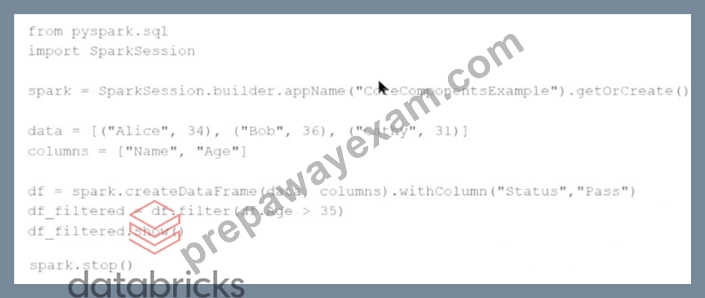
What is the role of the driver node?
- A. The driver node holds the DataFrame data and performs all computations locally
- B. The driver node only provides the user interface for monitoring the application
- C. The driver node stores the final result after computations are completed by worker nodes
- D. The driver node orchestrates the execution by transforming actions into tasks and distributing them to worker nodes
Answer: D
Explanation:
Comprehensive and Detailed Explanation From Exact Extract:
In the Spark architecture, the driver node is responsible for orchestrating the execution of a Spark application.
It converts user-defined transformations and actions into a logical plan, optimizes it into a physical plan, and then splits the plan into tasks that are distributed to the executor nodes.
As per Databricks and Spark documentation:
"The driver node is responsible for maintaining information about the Spark application, responding to a user's program or input, and analyzing, distributing, and scheduling work across the executors." This means:
Option A is correct because the driver schedules and coordinates the job execution.
Option B is incorrect because the driver does more than just UI monitoring.
Option C is incorrect since data and computations are distributed across executor nodes.
Option D is incorrect; results are returned to the driver but not stored long-term by it.
Reference: Databricks Certified Developer Spark 3.5 Documentation # Spark Architecture # Driver vs Executors.
NEW QUESTION # 60
......
Associate-Developer-Apache-Spark-3.5 Exam Dumps For Certification Exam Preparation: https://itcertspass.prepawayexam.com/Databricks/braindumps.Associate-Developer-Apache-Spark-3.5.ete.file.html