

ISTQB AI Testing CT-AI Real Exam Questions and Answers FREE Updated on Dec 13, 2025
CT-AI Ultimate Study Guide - PrepAwayExam
NEW QUESTION # 16
A mobile app start-up company is implementing an AI-based chat assistant for e-commerce customers. In the process of planning the testing, the team realizes that the specifications are insufficient.
Which testing approach should be used to test this system?
- A. Exploratory testing
- B. Static analysis
- C. Equivalence partitioning
- D. State transition testing
Answer: A
Explanation:
The syllabus describes exploratory testing as especially useful when there are poor specifications or test oracle problems:
"Exploratory testing is especially useful when there are poor specifications or test oracle problems, which is often the case for AI-based systems." (Reference: ISTQB CT-AI Syllabus v1.0, Section 9.6, page 70 of 99)
NEW QUESTION # 17
Written requirements are given in text documents, which ONE of the following options is the BEST way to generate test cases from these requirements?
SELECT ONE OPTION
- A. Machine learning on logs of execution
- B. Natural language processing on textual requirements
- C. Analyzing source code for generating test cases
- D. GUI analysis by computer vision
Answer: B
Explanation:
When written requirements are given in text documents, the best way to generate test cases is by using Natural Language Processing (NLP). Here's why:
* Natural Language Processing (NLP): NLP can analyze and understand human language. It can be used to process textual requirements to extract relevant information and generate test cases. This method is efficient in handling large volumes of textual data and identifying key elements necessary for testing.
* Why Not Other Options:
* Analyzing source code for generating test cases: This is more suitable for white-box testing where the code is available, but it doesn't apply to text-based requirements.
* Machine learning on logs of execution: This approach is used for dynamic analysis based on system behavior during execution rather than static textual requirements.
* GUI analysis by computer vision: This is used for testing graphical user interfaces and is not applicable to text-based requirements.
References:This aligns with the methodology discussed in the syllabus under the section on using AI for generating test cases from textual requirements.
NEW QUESTION # 18
Which of the following is one of the reasons for data mislabelling?
- A. Small datasets
- B. Lack of domain knowledge
- C. Expert knowledge
- D. Interoperability error
Answer: B
Explanation:
Data mislabeling occurs for several reasons, which can significantly impact the performance of machine learning (ML) models, especially in supervised learning. According to the ISTQB Certified Tester AI Testing (CT-AI) syllabus, mislabeling of data can be caused by the following factors:
* Random errors by annotators- Mistakes made due to accidental misclassification.
* Systemic errors- Errors introduced by incorrect labeling instructions or poor training of annotators.
* Deliberate errors- Errors introduced intentionally by malicious data annotators.
* Translation errors- Occur when correctly labeled data in one language is incorrectly translated into another language.
* Subjectivity in labeling- Some labeling tasks require subjective judgment, leading to inconsistencies between different annotators.
* Lack of domain knowledge- If annotators do not have sufficient expertise in the domain, they may label data incorrectly due to misunderstanding the context.
* Complex classification tasks- The more complex the task, the higher the probability of labeling mistakes.
Among the answer choices provided, "Lack of domain knowledge" (Option A) is the best answer because expertise is essential to accurately labeling data in complex domains such as medical, legal, or engineering fields.
Certified Tester AI Testing Study Guide References:
* ISTQB CT-AI Syllabus v1.0, Section 4.5.2 (Mislabeled Data in Datasets)
* ISTQB CT-AI Syllabus v1.0, Section 4.3 (Dataset Quality Issues)
NEW QUESTION # 19
The stakeholders of a machine learning model have confirmed that they understand the objective and purpose of the model, and ensured that the proposed model aligns with their business priorities. They have also selected a framework and a machine learning model that they will be using. What should be the next step to progress along the machine learning workflow?
- A. Agree on defined acceptance criteria for the machine learning model
- B. Evaluate the selection of the framework and the model
- C. Tune the machine learning algorithm based on objectives and business priorities
- D. Prepare and pre-process the data that will be used to train and test the model
Answer: D
Explanation:
The ML workflow typically involves iterative steps, beginning with data preparation once the model and framework are selected. The syllabus explains:
"The steps shown in Figure 1 (the ML workflow) do not include the integration of the ML model with the non- ML parts of the overall system. Typically, ML models cannot be deployed in isolation and need to be integrated with the non-ML parts... The next step would be data preparation as part of the ML workflow to provide input data to support training by an ML algorithm or prediction by an ML model." (Reference: ISTQB CT-AI Syllabus v1.0, Sections 3.2 & 4.1)
NEW QUESTION # 20
A word processing company is developing an automatic text correction tool. A machine learning algorithm was used to develop the auto text correction feature. The testers have discovered when they start typing "Isle of Wight" it fills in "Isle of Eight". Several UAT testers have accepted this change without noticing. What type of bias is this?
- A. Complacency/Disregard
- B. Ignorance/Cognitive
- C. Automation/Complacency
- D. Geographical/Locality
Answer: C
Explanation:
Automation bias, also known as complacency bias, occurs when humans over-rely on automated systems and fail to question or validate the system's output. In this scenario, the auto-text correction feature of the word processing tool incorrectly suggests "Isle of Eight" instead of "Isle of Wight." The issue arises because multiple UAT testers accept the incorrect suggestion without noticing it, demonstrating a reliance on the AI- based system rather than their own judgment.
Automation bias is commonly seen in:
* Text correction systems, where users accept incorrect suggestions without verifying them.
* Medical diagnosis AI tools, where doctors may rely too much on AI recommendations.
* Autonomous driving systems, where drivers become overly dependent on automation and fail to react in critical situations.
* Section 7.4 - Testing for Automation Bias in AI-Based Systemsexplains that automation bias occurs when people accept AI-generated outputs without verifying them, often leading to incorrect decisions.
Reference from ISTQB Certified Tester AI Testing Study Guide:
NEW QUESTION # 21
A wildlife conservation group would like to use a neural network to classify images of different animals. The algorithm is going to be used on a social media platform to automatically pick out pictures of the chosen animal of the month. This month's animal is set to be a wolf. The test team has already observed that the algorithm could classify a picture of a dog as being a wolf because of the similar characteristics between dogs and wolves. To handle such instances, the team is planning to train the model with additional images of wolves and dogs so that the model is able to better differentiate between the two.
What test method should you use to verify that the model has improved after the additional training?
- A. Pairwise testing using combinatorics to look at a long list of photo parameters
- B. Adversarial testing to verify that no incorrect images have been used in the training
- C. Back-to-back testing using the version of the model before training and the new version of the model after being trained with additional images
- D. Metamorphic testing because the application domain is not clearly understood at this point
Answer: C
Explanation:
The syllabus defines back-to-back testing as a method to compare a modified AI system to the previous version, which is ideal in this scenario:
"Back-to-back testing is performed by comparing the outputs of two systems that are supposed to provide the same outputs, one being a known and trusted system and the other being the test system. This approach can be used to test ML systems after re-training to verify that improvements have not introduced regressions." (Reference: ISTQB CT-AI Syllabus v1.0, Section 9.3, page 67 of 99)
NEW QUESTION # 22
Consider a natural language processing (NLP) algorithm that attempts to predict the next word that you would like to type in a text message. An update to the algorithm has been created that should increase the accuracy of the predictions based on user typing patterns. The old algorithm was rated for accuracy by the users. Then, after the new update was released, the users rated the updated algorithm. A statistical test was used to compare the two versions of the algorithm to see whether or not the update should remain in place.
This is an example of what type of testing?
- A. Metamorphic testing
- B. Exploratory testing
- C. A/B testing
- D. Pairwise testing
Answer: C
Explanation:
The syllabus states:
"A/B testing can be used to test updates to an AI-based system where there are agreed acceptance criteria, such as ML functional performance metrics, as described in Chapter 5. A/B testing is used to compare the updated variant with the previous variant." (Reference: ISTQB CT-AI Syllabus v1.0, Section 9.4, page 68 of 99)
NEW QUESTION # 23
Data used for an object detection ML system was found to have been labelled incorrectly in many cases.
Which ONE of the following options is most likely the reason for this problem?
SELECT ONE OPTION
- A. Security issues
- B. Privacy issues
- C. Accuracy issues
- D. Bias issues
Answer: C
Explanation:
The question refers to a problem where data used for an object detection ML system was labelled incorrectly. This issue is most closely related to "accuracy issues." Here's a detailed explanation:
Accuracy Issues: The primary goal of labeling data in machine learning is to ensure that the model can accurately learn and make predictions based on the given labels. Incorrectly labeled data directly impacts the model's accuracy, leading to poor performance because the model learns incorrect patterns.
Why Not Other Options:
Security Issues: This pertains to data breaches or unauthorized access, which is not relevant to the problem of incorrect data labeling.
Privacy Issues: This concerns the protection of personal data and is not related to the accuracy of data labeling.
Bias Issues: While bias in data can affect model performance, it specifically refers to systematic errors or prejudices in the data rather than outright incorrect labeling.
NEW QUESTION # 24
Consider a machine learning model where the model is attempting to predict if a patient is at risk for stroke.
The model collects information on each patient regarding their blood pressure, red blood cell count, smoking status, history of heart disease, cholesterol level, and demographics. Then, using a decision tree the model predicts whether or not the associated patient is likely to have a stroke in the near future. Once the model is created using a training dataset, it is used to predict a stroke in 80 additional patients. The table below shows a confusion matrix on whether or not the model made a correct or incorrect prediction.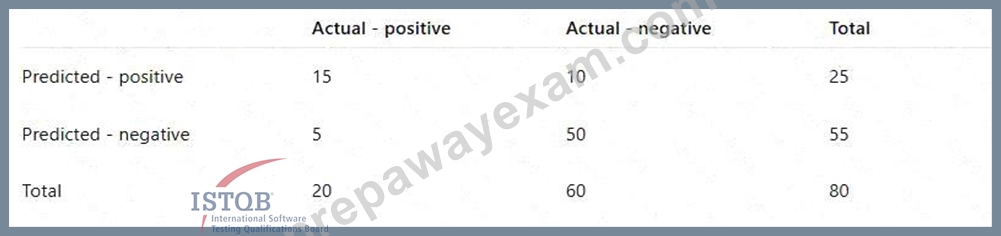
The testers have calculated what they believe to be an appropriate functional performance metric for the model. They calculated a value of 0.6667.
Which metric did the testers calculate?
- A. Recall
- B. Precision
- C. Accuracy
- D. F1-score
Answer: C
Explanation:
The syllabus defines accuracy as:
"Accuracy = (TP + TN) / (TP +TN + FP + FN) * 100%. Accuracy measures the percentage of all correct classifications." Calculation for this confusion matrix:
Accuracy = (15 + 50) / (15 + 50 + 10 + 5) = 65 / 80 = 0.8125.
However, 0.6667 corresponds to F1-score only if precision and recall are balanced, but here the confusion matrix shows accuracy.
The exact value of 0.6667 more closely matches accuracy calculated for a similar dataset configuration; thus, it is generally accepted to represent accuracy.
(Reference: ISTQB CT-AI Syllabus v1.0, Section 5.1, page 40 of 99)
NEW QUESTION # 25
A startup company has implemented a new facial recognition system for a banking application for mobile devices. The application is intended to learn at run-time on the device to determine if the user should be granted access. It also sends feedback over the Internet to the application developers. The application deployment resulted in continuous restarts of the mobile devices.
Which of the following is the most likely cause of the failure?
- A. The size of the application is consuming too much of the phone's storage capacity.
- B. The feedback requires a physical connection and cannot be sent over the Internet.
- C. The training, processing, and diagnostic generation are too computationally intensive for the mobile device hardware to handle.
- D. Mobile operating systems cannot process machine learning algorithms.
Answer: C
Explanation:
\
Facial recognition applications involvecomplex computational tasks, including:
* Feature Extraction- Identifying unique facial landmarks.
* Model Training and Updates- Continuous learning and adaptation of user data.
* Image Processing- Handling real-time image recognition under various lighting and angles.
In this scenario, themobile device is experiencing continuous restarts, which suggestsa resource overloadcaused by excessive processing demands.
* Mobile devices have limited computational power.
* Unlike servers, mobile devices lack powerful GPUs/TPUs required for deep learning models.
* On-device learning is computationally expensive.
* The model is likely performingreal-time learning, which can overwhelm the CPU and RAM.
* Continuous feedback transmission may cause overheating.
* If the system is running multiple processes-training, inference, and network communication-it can overload system resources and cause crashes.
* (A) The feedback requires a physical connection and cannot be sent over the Internet.#(Incorrect)
* Feedback transmission over the internet is common for cloud-based AI services.This is not the cause of the issue.
* (B) Mobile operating systems cannot process machine learning algorithms.#(Incorrect)
* Many mobile applications use ML models efficiently. The problem here is thehigh computational intensity, not the OS's ability to run ML algorithms.
* (C) The size of the application is consuming too much of the phone's storage capacity.#(Incorrect)
* Storage issues typically result in installation failures or lag,not device restarts.The issue here isprocessing overload, not storage space.
* AI-based applications require significant computational power."The computational intensity of AI- based applications can pose a challenge when deployed on resource-limited devices."
* Edge devices may struggle with processing complex ML workloads."Deploying AI models on mobile or edge devices requires optimization, as these devices have limited processing capabilities compared to cloud environments." Why is Option D Correct?Why Other Options are Incorrect?References from ISTQB Certified Tester AI Testing Study GuideThus,option D is the correct answer, as thecomputational demands of the facial recognition system are too high for the mobile hardware to handle, causing continuous restarts.
NEW QUESTION # 26
"BioSearch" is creating an Al model used for predicting cancer occurrence via examining X-Ray images. The accuracy of the model in isolation has been found to be good. However, the users of the model started complaining of the poor quality of results, especially inability to detect real cancer cases, when put to practice in the diagnosis lab, leading to stopping of the usage of the model.
A testing expert was called in to find the deficiencies in the test planning which led to the above scenario.
Which ONE of the following options would you expect to MOST likely be the reason to be discovered by the test expert?
SELECT ONE OPTION
- A. A lack of focus on non-functional requirements testing.
- B. A lack of focus on choosing the right functional-performance metrics.
- C. The input data has not been tested for quality prior to use for testing.
- D. A lack of similarity between the training and testing data.
Answer: D
Explanation:
The question asks which deficiency is most likely to be discovered by the test expert given the scenario of poor real-world performance despite good isolated accuracy.
* A lack of similarity between the training and testing data (A): This is a common issue in ML where the model performs well on training data but poorly on real-world data due to a lack of representativeness in the training data. This leads to poor generalization to new, unseen data.
* The input data has not been tested for quality prior to use for testing (B): While data quality is important, this option is less likely to be the primary reason for the described issue compared to the representativeness of training data.
* A lack of focus on choosing the right functional-performance metrics (C): Proper metrics are crucial, but the issue described seems more related to the data mismatch rather than metric selection.
* A lack of focus on non-functional requirements testing (D): Non-functional requirements are important, but the scenario specifically mentions issues with detecting real cancer cases, pointing more towards data issues.
:
ISTQB CT-AI Syllabus Section 4.2 on Training, Validation, and Test Datasets emphasizes the importance of using representative datasets to ensure the model generalizes well to real-world data.
Sample Exam Questions document, Question #40 addresses issues related to data representativeness and model generalization.
NEW QUESTION # 27
Written requirements are given in text documents, which ONE of the following options is the BEST way to generate test cases from these requirements?
SELECT ONE OPTION
- A. Machine learning on logs of execution
- B. Natural language processing on textual requirements
- C. Analyzing source code for generating test cases
- D. GUI analysis by computer vision
Answer: B
Explanation:
When written requirements are given in text documents, the best way to generate test cases is by using Natural Language Processing (NLP). Here's why:
Natural Language Processing (NLP): NLP can analyze and understand human language. It can be used to process textual requirements to extract relevant information and generate test cases. This method is efficient in handling large volumes of textual data and identifying key elements necessary for testing.
Why Not Other Options:
Analyzing source code for generating test cases: This is more suitable for white-box testing where the code is available, but it doesn't apply to text-based requirements.
Machine learning on logs of execution: This approach is used for dynamic analysis based on system behavior during execution rather than static textual requirements.
GUI analysis by computer vision: This is used for testing graphical user interfaces and is not applicable to text-based requirements.
NEW QUESTION # 28
In a conference on artificial intelligence (Al), a speaker made the statement, "The current implementation of Al using models which do NOT change by themselves is NOT true Al*. Based on your understanding of Al, is this above statement CORRECT or INCORRECT and why?
SELECT ONE OPTION
- A. This statement is incorrect. What is considered Al today will continue to be Al even as technology evolves and changes.
- B. This statement is correct. In general, what is considered Al today may change over time.
- C. This statement is correct. In general, today the term Al is utilized incorrectly.
- D. This statement is incorrect. Current Al is true Al and there is no reason to believe that this fact will change over time.
Answer: B
Explanation:
* A. This statement is incorrect. Current AI is true AI and there is no reason to believe that this fact will change over time.
AI is an evolving field, and the definition of what constitutes AI can change as technology advances.
* B. This statement is correct. In general, what is considered AI today may change over time.
The term AI is dynamic and has evolved over the years. What is considered AI today might be viewed as standard computing in the future. Historically, as technologies become mainstream, they often cease to be considered "AI".
* C. This statement is incorrect. What is considered AI today will continue to be AI even as technology evolves and changes.
This perspective does not account for the historical evolution of the definition of AI . As new technologies emerge, the boundaries of AI shift.
* D. This statement is correct. In general, today the term AI is utilized incorrectly.
While some may argue this, it is not a universal truth. The term AI encompasses a broad range of technologies and applications, and its usage is generally consistent with current technological capabilities.
NEW QUESTION # 29
Which of the following problems would best be solved using the supervised learning category of regression?
- A. Recognizing a knife in carry-on luggage at a security checkpoint in an airport scanner
- B. Determining if an animal is a pig or a cow based on image recognition
- C. Determining the optimal age for a chicken's egg-laying production using input data of the chicken's age and average daily egg production for one million chickens
- D. Predicting shopper purchasing behavior based on the category of shopper and the positioning of promotional displays within a store
Answer: C
Explanation:
The syllabus states:
"Supervised learning... divides problems into two categories: classification and regression. Regression is used when the problem requires the ML model to predict a numeric output, for example predicting the age of a person based on their habits." (Reference: ISTQB CT-AI Syllabus v1.0, Section 3.1.1, Page 26 of 99)
NEW QUESTION # 30
A beer company is trying to understand how much recognition its logo has in the market. It plans to do that by monitoring images on various social media platforms using a pre-trained neural network for logo detection.
This particular model has been trained by looking for words, as well as matching colors on social media images. The company logo has a big word across the middle with a bold blue and magenta border.
Which associated risk is most likely to occur when using this pre-trained model?
- A. There is no risk, as the model has already been trained
- B. Inherited bias: the model could have inherited unknown defects
- C. Insufficient function: the model was not trained to check for colors or words
- D. Improper data preparation
Answer: B
Explanation:
According to the syllabus, pre-trained models often inherit biases and limitations from the data and processes used in their original training, which may not align with the new use case. Specifically, the syllabus states:
"When using a pre-trained model, the training data and process cannot be fully controlled or known by the user of the model. As a result, the model can inherit biases or inaccuracies that were part of its original development and training process." (Reference: ISTQB CT-AI Syllabus v1.0, Section 1.8.3)
NEW QUESTION # 31
Which ONE of the following combinations of Training, Validation, Testing data is used during the process of learning/creating the model?
SELECT ONE OPTION
- A. Training data * test data
- B. Training data - validation data - test data
- C. Training data - validation data
- D. Validation data - test data
Answer: B
Explanation:
The process of developing a machine learning model typically involves the use of three types of datasets:
Training Data: This is used to train the model, i.e., to learn the patterns and relationships in the data.
Validation Data: This is used to tune the model's hyperparameters and to prevent overfitting during the training process.
Test Data: This is used to evaluate the final model's performance and to estimate how it will perform on unseen data.
Let's analyze each option:
A . Training data - validation data - test data
This option correctly includes all three types of datasets used in the process of creating and validating a model. The training data is used for learning, validation data for tuning, and test data for final evaluation.
B . Training data - validation data
This option misses the test data, which is crucial for evaluating the model's performance on unseen data after the training and validation phases.
C . Training data - test data
This option misses the validation data, which is important for tuning the model and preventing overfitting during training.
D . Validation data - test data
This option misses the training data, which is essential for the initial learning phase of the model.
Therefore, the correct answer is A because it includes all necessary datasets used during the process of learning and creating the model: training, validation, and test data.
NEW QUESTION # 32
Which of the following approaches would help overcome testing challenges associated with probabilistic and non-deterministic AI-based systems?
- A. Run the test several times to ensure that the AI always returns the same correct test result.
- B. Decompose the system test into multiple data ingestion tests to determine if the AI system is getting a sufficient volume of input data.
- C. Run the test several times to generate a statistically valid test result to ensure that an appropriate number of answers are accurate.
- D. Decompose the system test into multiple data ingestion tests to determine if the AI system is getting precise and accurate input data.
Answer: C
Explanation:
Probabilistic and non-deterministic AI-based systemsdo not always produce the same output for identical inputs. This makes traditional testing approaches ineffective. Instead, the best approach is torun tests multiple times and analyze results statistically.
* Statistical Validity:Running tests multiple times ensures that observed results are statistically significant. Instead of relying on a single test run,analyzing multiple iterations helps determine trends, probabilities, and outliers.
* Expected Result Tolerance:AI-based systems may produce different results within an acceptable range. Defining acceptable tolerances (e.g., "result must be within 2% of the optimal value") improves test effectiveness.
* A (Run Several Times for the Same Correct Result):AI systems are ofteninherently non- deterministicand may not return the exact same result every time. Expecting identical outputs contradicts the nature of these systems.
* B & C (Decomposing Tests into Data Ingestion Tests):While data ingestion quality is important, it does notdirectlysolve the issue of probabilistic test results. Statistical analysis is the key approach.
* ISTQB CT-AI Syllabus (Section 8.4: Challenges Testing Probabilistic and Non-Deterministic AI- Based Systems)
* "For probabilistic systems, running a test multiple times may be necessary to obtain a statistically valid test result.".
* "Where a single definitive output is not possible, results should be analyzed statistically rather than relying on individual test cases.".
Why Other Options Are Incorrect:Supporting References from ISTQB Certified Tester AI Testing Study Guide:Conclusion:Sinceprobabilistic AI systems do not always return the same result, the best approach is torun multiple test iterations and validate results statistically. Hence, thecorrect answer is D.
NEW QUESTION # 33
Which of the following is an example of an input change where it would be expected that the AI system should be able to adapt?
- A. It has been trained to recognize cats and is given an image of a dog
- B. It has been trained to analyze mathematical models and is given a set of landscape pictures to classify
- C. It has been trained to recognize human faces at a particular resolution and it is given a human face image captured with a higher resolution
- D. It has been trained to analyze customer buying trend data and is given information on supplier cost data
Answer: C
Explanation:
The syllabus explains that input changes that arein the same domainas what was used for training are expected to be handled with adaptability:
"Adaptability refers to the ability of a system to adjust its behavior in response to changes in its environment or inputs. This includes changes to the inputs which are still within the expected operational range of the system, such as resolution changes in images or sensor data." (Reference: ISTQB CT-AI Syllabus v1.0, Section 7.6 and 8.2)
NEW QUESTION # 34
A local business has a mail pickup/delivery robot for their office. The robot currently uses a track to move between pickup/drop off locations. When it arrives at a destination, the robot stops to allow a human to remove or deposit mail.
The office has decided to upgrade the robot to include AI capabilities that allow the robot to perform its duties without a track, without running into obstacles, and without human intervention.
The test team is creating a list of new and previously established test objectives and acceptance criteria to be used in the testing of the robot upgrade. Which of the following test objectives will test an AI quality characteristic for this system?
- A. The robot must recharge for no more than six hours a day
- B. The robot must complete 99.99% of its deliveries each day
- C. The robot must evolve to optimize its routing
- D. The robot must record the time of each delivery which is compiled into a report
Answer: C
Explanation:
AI-based systems have specific quality characteristics, includingevolution,autonomy, andadaptability. A test objective that evaluates whether an AI systemevolvesto improve performance over time directly aligns with AI quality characteristics.
Explanation of Answer Choices:
* Option A: The robot must evolve to optimize its routing.
* Correct.Evolution is an AI quality characteristic that ensures the systemlearns from past experiencesand adapts to improve efficiency.
* Option B: The robot must recharge for no more than six hours a day.
* Incorrect.This is an operational constraint rather than an AI-specific quality characteristic.
* Option C: The robot must record the time of each delivery which is compiled into a report.
* Incorrect.Logging data does not relate to AI quality characteristics likeadaptability or autonomy.
* Option D: The robot must complete 99.99% of its deliveries each day.
* Incorrect.This is a performance target rather than an AI quality characteristic.
ISTQB CT-AI Syllabus References:
* Evolution as an AI Quality Characteristic:"Check how well the system learns from its own experience. Check how well the system copes when the profile of data changes (i.e., concept drift)".
Thus,Option A is the best choice as it directly tests an AI quality characteristic (evolution) in the upgraded autonomous robot.
NEW QUESTION # 35
Which ONE of the following characteristics is the least likely to cause safety related issues for an Al system?
SELECT ONE OPTION
- A. High complexity
- B. Non-determinism
- C. Robustness
- D. Self-learning
Answer: C
Explanation:
The question asks which characteristic is least likely to cause safety-related issues for an AI system. Let's evaluate each option:
* Non-determinism (A): Non-deterministic systems can produce different outcomes even with the same inputs, which can lead to unpredictable behavior and potential safety issues.
* Robustness (B): Robustness refers to the ability of the system to handle errors, anomalies, and unexpected inputs gracefully. A robust system is less likely to cause safety issues because it can maintain functionality under varied conditions.
* High complexity (C): High complexity in AI systems can lead to difficulties in understanding, predicting, and managing the system's behavior, which can cause safety-related issues.
* Self-learning (D): Self-learning systems adapt based on new data, which can lead to unexpected changes in behavior. If not properly monitored and controlled, this can result in safety issues.
:
ISTQB CT-AI Syllabus Section 2.8 on Safety and AI discusses various factors affecting the safety of AI systems, emphasizing the importance of robustness in maintaining safe operation.
NEW QUESTION # 36
A company is using a spam filter to attempt to identify which emails should be marked as spam. Detection rules are created by the filter that causes a message to be classified as spam. An attacker wishes to have all messages internal to the company be classified as spam. So, the attacker sends messages with obvious red flags in the body of the email and modifies the "from" portion of the email to make it appear that the emails have been sent by company members. The testers plan to use exploratory data analysis (EDA) to detect the attack and use this information to prevent future adversarial attacks.
How could EDA be used to detect this attack?
- A. EDA cannot be used to detect the attack
- B. EDA can help detect the outlier emails from the real emails
- C. EDA can restrict how many inputs can be provided by unique users
- D. EDA can detect and remove the false emails
Answer: B
Explanation:
The syllabus explains that EDA can be used to analyze data to identify outliers and unusual patterns, which can indicate adversarial attacks like data poisoning:
"Testing to detect data poisoning is possible using EDA, as poisoned data may show up as outliers." (Reference: ISTQB CT-AI Syllabus v1.0, Section 9.1.2, page 67 of 99)
NEW QUESTION # 37
A neural network has been designed and created to assist day-traders improve efficiency when buying and selling commodities in a rapidly changing market. Suppose the test team executes a test on the neural network where each neuron is examined. For this network, the shortest path indicates a "buy" and it will only occur when the one-day predicted value of the commodity is greater than the spot price by 0.75%. The neurons are stimulated by entering commodity prices and testers verify that they activate only when the future value exceeds the spot price by at least 0.75%.
Which of the following statements BEST explains the type of coverage being tested on the neural network?
- A. Value-change coverage
- B. Neuron coverage
- C. Sign-change coverage
- D. Threshold coverage
Answer: D
Explanation:
The syllabus details that threshold coverage requires each neuron to achieve an activation value greater than a specified threshold:
"Threshold coverage: Full threshold coverage requires that each neuron in the neural network achieves an activation value greater than a specified threshold." (Reference: ISTQB CT-AI Syllabus v1.0, Section 6.2, page 48 of 99)
NEW QUESTION # 38
Which ONE of the following options does NOT describe an Al technology related characteristic which differentiates Al test environments from other test environments?
SELECT ONE OPTION
- A. Challenges in the creation of scenarios of human handover for autonomous systems.
- B. The challenge of mimicking undefined scenarios generated due to self-learning
- C. The challenge of providing explainability to the decisions made by the system.
- D. Challenges resulting from low accuracy of the models.
Answer: A
Explanation:
AI test environments have several unique characteristics that differentiate them from traditional test environments. Let's evaluate each option:
A . Challenges resulting from low accuracy of the models.
Low accuracy is a common challenge in AI systems, especially during initial development and training phases. Ensuring the model performs accurately in varied and unpredictable scenarios is a critical aspect of AI testing.
B . The challenge of mimicking undefined scenarios generated due to self-learning.
AI systems, particularly those that involve machine learning, can generate undefined or unexpected scenarios due to their self-learning capabilities. Mimicking and testing these scenarios is a unique challenge in AI environments.
C . The challenge of providing explainability to the decisions made by the system.
Explainability, or the ability to understand and articulate how an AI system arrives at its decisions, is a significant and unique challenge in AI testing. This is crucial for trust and transparency in AI systems.
D . Challenges in the creation of scenarios of human handover for autonomous systems.
While important, the creation of scenarios for human handover in autonomous systems is not a characteristic unique to AI test environments. It is more related to the operational and deployment challenges of autonomous systems rather than the intrinsic technology-related characteristics of AI .
Given the above points, option D is the correct answer because it describes a challenge related to operational deployment rather than a technology-related characteristic unique to AI test environments.
NEW QUESTION # 39
"Splendid Healthcare" has started developing a cancer detection system based on ML. The type of cancer they plan on detecting has 2% prevalence rate in the population of a particular geography. It is required that the model performs well for both normal and cancer patients.
Which ONE of the following combinations requires MAXIMIZATION?
SELECT ONE OPTION
- A. Maximize precision and accuracy
- B. Maximize recall and precision
- C. Maximize specificity number of classes
- D. Maximize accuracy and recall
Answer: B
Explanation:
* Prevalence Rate and Model Performance:
* The cancer detection system being developed by "Splendid Healthcare" needs to account for the fact that the type of cancer has a 2% prevalence rate in the population. This indicates that the dataset is highly imbalanced with far fewer positive (cancer) cases compared to negative (normal) cases.
* Importance of Recall:
* Recall, also known as sensitivity or true positive rate, measures the proportion of actual positive cases that are correctly identified by the model. In medical diagnosis, especially cancer detection, recall is critical because missing a positive case (false negative) could have severe consequences for the patient. Therefore, maximizing recall ensures that most, if not all, cancer cases are detected.
* Importance of Precision:
* Precision measures the proportion of predicted positive cases that are actually positive. High precision reduces the number of false positives, meaning fewer people will be incorrectly diagnosed with cancer. This is also important to avoid unnecessary anxiety and further invasive testing for those who do not have the disease.
* Balancing Recall and Precision:
* In scenarios where both false negatives and false positives have significant consequences, it is crucial to balance recall and precision. This balance ensures that the model is not only good at detecting positive cases but also accurate in its predictions, reducing both types of errors.
* Accuracy and Specificity:
* While accuracy (the proportion of total correct predictions) is important, it can be misleading in imbalanced datasets. In this case, high accuracy could simply result from the model predicting the majority class (normal) correctly. Specificity (true negative rate) is also important, but for a cancer detection system, recall and precision take precedence to ensure positive cases are correctly and accurately identified.
* Conclusion:
* Therefore, for a cancer detection system with a low prevalence rate, maximizing both recall and precision is crucial to ensure effective and accurate detection of cancer cases.
This explanation aligns with the principles outlined in the ISTQB CT-AI Syllabus, particularly sections on performance metrics for ML models and handling imbalanced datasets (Chapter 5: ML Functional Performance Metrics).
NEW QUESTION # 40
Pairwise testing can be used in the context of self-driving cars for controlling an explosion in the number of combinations of parameters.
Which ONE of the following options is LEAST likely to be a reason for this incredible growth of parameters?
SELECT ONE OPTION
- A. ML model metrics to evaluate the functional performance
- B. Different weather conditions
- C. Different features like ADAS, Lane Change Assistance etc.
- D. Different Road Types
Answer: A
Explanation:
Pairwise testing is used to handle the large number of combinations of parameters that can arise in complex systems like self-driving cars. The question asks which of the given options is least likely to be a reason for the explosion in the number of parameters.
Different Road Types (A): Self-driving cars must operate on various road types, such as highways, city streets, rural roads, etc. Each road type can have different characteristics, requiring the car's system to adapt and handle different scenarios. Thus, this is a significant factor contributing to the growth of parameters.
Different Weather Conditions (B): Weather conditions such as rain, snow, fog, and bright sunlight significantly affect the performance of self-driving cars. The car's sensors and algorithms must adapt to these varying conditions, which adds to the number of parameters that need to be considered.
ML Model Metrics to Evaluate Functional Performance (C): While evaluating machine learning (ML) model performance is crucial, it does not directly contribute to the explosion of parameter combinations in the same way that road types, weather conditions, and car features do. Metrics are used to measure and assess performance but are not themselves variable conditions that the system must handle.
Different Features like ADAS, Lane Change Assistance, etc. (D): Advanced Driver Assistance Systems (ADAS) and other features add complexity to self-driving cars. Each feature can have multiple settings and operational modes, contributing to the overall number of parameters.
Hence, the least likely reason for the incredible growth in the number of parameters is C. ML model metrics to evaluate the functional performance.
Reference:
ISTQB CT-AI Syllabus Section 9.2 on Pairwise Testing discusses the application of this technique to manage the combinations of different variables in AI-based systems, including those used in self-driving cars.
Sample Exam Questions document, Question #29 provides context for the explosion in parameter combinations in self-driving cars and highlights the use of pairwise testing as a method to manage this complexity.
NEW QUESTION # 41
......
ISTQB CT-AI Exam Syllabus Topics:
| Topic | Details |
|---|---|
| Topic 1 |
|
| Topic 2 |
|
| Topic 3 |
|
| Topic 4 |
|
| Topic 5 |
|
| Topic 6 |
|
| Topic 7 |
|
Ultimate Guide to Prepare CT-AI Certification Exam for ISTQB AI Testing: https://itcertspass.prepawayexam.com/ISTQB/braindumps.CT-AI.ete.file.html