

Check Real Guidewire InsuranceSuite-Developer Exam Question for Free (2026)
Get Ready to Boost your Prepare for your InsuranceSuite-Developer Exam with 79 Questions
NEW QUESTION # 10
An insurer ran the DBCC checks against a copy of their production database and found three errors with high counts in the categoryData update and reconciliation. What are two best practices for resolving the errors?
(Select two)
- A. Identify any bad data and write a SQL script to correct the data; run the script immediately
- B. Analyze the errors to determine the root cause and correct the code responsible for the errors
- C. Wait to see if error counts increase; if they increase by more than 10%, fix the errors
- D. Search the Knowledge Base on the Guidewire Community for solutions to the problems found
- E. Promote the code to production and run the DBCCs again
Answer: B,D
Explanation:
Database Consistency Checks (DBCCs) are the "canary in the coal mine" for data integrity. When high error counts appear in theData update and reconciliationcategory, it usually implies that recent configuration changes (Gosu rules, enhancements, or batch processes) are generating data that violates the underlying metadata constraints.
The first best practice isRoot Cause Analysis(Option A). Simply fixing the data in the database is a "band- aid" solution; if the underlying Gosu code that created the bad data is not fixed, the errors will immediately return. Developers must trace the lifecycle of the affected entities to find where the logic is failing.
The second best practice is to leverage theGuidewire Community Knowledge Base(Option E). Many DBCC errors, especially those following a version upgrade or a major configuration change, have been encountered by other insurers. The Knowledge Base often provides specific SQL patterns or Gosu fixes tailored to known platform behaviors.
Why other options are incorrect:
* Option Bis dangerous; never promote code known to cause database inconsistencies to a production environment.
* Option Cis irresponsible; data corruption should be addressed as soon as it is detected.
* Option Dis a partial fix, but "running the script immediately" without a code fix or support review (as discussed in Question 61) is high-risk and violates Cloud Assurance standards.
NEW QUESTION # 11
The Cost entity contains the fields TotalPremium and Tax. The application needs to calculate the total cost as a sum of those two fields dynamically and wants to create a reusable solution. Which configuration is appropriate and efficient to achieve this task?
- A. Create an entity extension and add a new field to store the total cost.
- B. Calculate the total cost in the value property in the PCF file.
- C. Create an entity enhancement and add: property set TotalCost_Ext(totalCost : BigDecimal){ totalCost = this.TotalPremium + this.Tax }
- D. Add a getter in CostEnhancement: property get TotalCost_Ext() : BigDecimal { return this.
TotalPremium + this.Tax }
Answer: D
Explanation:
In Guidewire development, the best practice for adding derived or calculated logic to an entity is using aGosu Enhancement. An enhancement allows you to add methods and properties to a base entity without modifying the underlying physical database schema or the original .eti file.
According to theInsuranceSuite Developer Fundamentalscourse, aread-only property (getter)is the most appropriate way to handle a dynamic calculation like "Total Cost." By defining a property get, the value is calculated on-the-fly whenever it is accessed. This ensures the data is always accurate and reflects the current state of TotalPremium and Tax without the risk of data desynchronization.
Option C is inefficient because adding a physical column to the database for a value that can be easily derived increases database size and requires complex logic to keep the "stored" total in sync with the source fields.
Option D is an anti-pattern; while calculating in a PCF works, it is notreusable-if you needed the total in a different page or a business rule, you would have to duplicate the logic. Option B is logically incorrect as a property set is used to assign values, not to return a calculated result.
NEW QUESTION # 12
Automated inspections help enforce quality by identifying anomalous code and adherence to defined metrics.
Which types of issues or rules are typically enforced by Guidewire Studio Inspections? Select Two
- A. Measurement of the Cyclomatic Complexity metric to ensure methods do not exceed 40 statements.
- B. Detection of memory leaks caused by large, long-running bundles that were not paged correctly during batch modification.
- C. Identification of potential programming bugs, such as empty if or else statements or unused loop variables.
- D. Verification of data integrity to ensure that required columns on subtypes are correctly populated (a platform-level Database Consistency Check).
- E. Enforcement of naming standards for method and variable declarations across the entire Gosu configuration.
- F. Detection of unaccounted-for time (Own Time) during server round trips, indicating inefficient processing loops.
Answer: C,E
Explanation:
Guidewire Studio Inspections are a form of static code analysis performed within the integrated development environment (IDE). These inspections analyze the Gosu source code and PCF files without actually executing the application. According to the "System Health & Quality" lesson, the primary goal of these inspections is to ensure code maintainability, readability, and the prevention of common logical errors.
One of the most critical roles of Studio Inspections is theenforcement of naming standards(Option B).
Guidewire has strict conventions for how classes, methods, and variables should be named (e.g., camelCase for variables, PascalCase for classes, and the use of the _Ext suffix for customer extensions). Inspections flag any deviations from these standards, ensuring that custom code blends seamlessly with the base product code.
This is vital for long-term maintenance and multi-developer collaboration.
Additionally, inspections are designed for theidentification of potential programming bugs(Option E). This includes detecting "code smells" such as empty if, else, or catch blocks, which often indicate incomplete logic or forgotten error handling. It also identifies unused variables, unreachable code, or potentially dangerous null pointer scenarios. By catching these issues at design-time, developers can resolve them before the code is even committed to the repository.
Other options refer to different tools: Option A describes theGuidewire Profiler(used at runtime), Option D describesDatabase Consistency Checks(DBCC), and Option F refers to memory monitoring and bundle management best practices that are generally outside the scope of basic static inspections. Studio Inspections focus specifically on the "health" of the source code itself.
NEW QUESTION # 13
Which GUnit base class is used for tests that involve Gosu queries in PolicyCenter?
- A. SuiteDBTestClassBase
- B. GUnitTestClassBase
- C. PCUnitTestClassBase
- D. PCServerTestClassBase
Answer: D
Explanation:
In theGuidewire System Health & Qualitytraining, understanding the hierarchy of GUnit base classes is essential for writing effective automated tests.
While GUnitTestClassBase (Option A) provides basic testing functionality, it does not necessarily initialize the full application server environment or the database connection required for complex operations. For tests that require thefull Guidewire stack-including the ability to executeGosu queriesagainst the database or interact with the bundle-developers must usePCServerTestClassBase(Option D) in PolicyCenter (or CCServerTestClassBase in ClaimCenter).
This base class ensures that:
* The Guidewire Application Server environment is "mocked" or started.
* The current user session is authenticated.
* The database transaction manager (Bundles) is available for queries and commits.
Using a lower-level base class for a query-based test would result in a NullPointerException or a NoSessionException because the Query API requires an active server context to translate Gosu into SQL.
NEW QUESTION # 14
An InsuranceSuite implementation project is preparing for deployment to the Guidewire Cloud Platform.
Which two Cloud Delivery Standards must be met before deployment? (Select two)
- A. Log files contain no PII (Personally Identifiable Information) as clear text
- B. There are no instances of single statements with multiple expansion operators(*)
- C. GUnit tests must be combined into suites and executed in Studio prior to each code deployment
- D. The default system user su is configured as the second argument of the runWithNewBundle method
- E. New entities and new columns added to existing entities use a customer suffix such as _Si
Answer: A,E
Explanation:
Moving to theGuidewire Cloud Platform (GWCP)introduces a set of mandatory "Cloud Delivery Standards" designed to ensure that customer implementations are secure, upgradeable, and performant. Two of the most critical pillars in these standards areMetadata Naming ConventionsandData Privacy/Security.
First, naming conventions (Option D) are essential for maintaining the "Upgrade-Safe" nature of the cloud. In Guidewire Cloud, the base product is updated frequently. To prevent custom metadata (new entities or columns) from conflicting with future Guidewire base product releases, all extensions must use a unique customer suffix. While the standard example is _Ext, insurers often use their specific company initials, such as _Si for Succeed Insurance. This ensures that the custom data model remains distinct from the gw namespace.
Second, theObservabilityandSecuritystandards strictly forbid the logging ofPersonally Identifiable Information (PII)in plain text (Option E). In the cloud, logs are aggregated and viewed via tools like CloudWatch or Kibana. If sensitive data like Social Security Numbers, Credit Card numbers, or personal addresses are logged as clear text, it constitutes a major security risk and a violation of compliance standards like GDPR or SOC2. Guidewire's automatedQuality Gateswill often block a deployment if it detects potential PII leakage in the Gosu logging code.
Options A and B are general development practices but not the primary delivery standards that block deployment. Option C is actually a security risk; hardcoding the "su" (Super User) in bundle management is generally discouraged in favor of more granular permission handling.
NEW QUESTION # 15
The following Gosu statement is the Action part of a validation rule:
It produces the following compilation error:
Gosu compiler: Wrong number of arguments to function rejectFieldQava.lang.String, typekey.
ValidationLevel, java.lang.string, typekey.ValidationLevel, java.lang.string). Expected 5, got 3 What needs to be added to or deleted from the statement to clear the error?
- A. The two nulls must be replaced with a typekey and a string
- B. A left parenthesis must be delete
- C. The word "State' must be replaced with a DisplayKey
- D. A right parenthesis must be added.
Answer: A
Explanation:
In GuidewireValidation Rules, the rejectField method is a critical tool for identifying specific fields that fail business logic checks. This method allows the application to highlight the exact UI widget in red and provide a specific error message to the user.
As indicated by the compiler error, the rejectField method on a Guidewire entity (like Contact or Claim) has a very specific signature that requiresfive parameters:
* Field Name (String):The name of the property being validated (e.g., "State").
* Validation Level (ValidationLevel):The severity of the failure (e.g., TC_LOADSAVE).
* Error Message (String):The text displayed to the user.
* Error Group (ValidationLevel):An optional group for categorizing the error.
* Error ID (String):An optional unique identifier for the specific error.
When the compiler reports"Expected 5, got 3", it means the developer only provided the first three arguments. To resolve this error according to Guidewire best practices, the developer must complete the signature. While null is often passed for the final two arguments if they are not needed, the compiler requires them to be present so it can identify which version of the overloaded rejectField method is being called.
The reason Option A is the recognized answer in this context is that simply adding null, null is often insufficient if the types aren't explicitly recognized or if the code had "placeholder" nulls that didn't match the expected typekey/string types. By ensuring the 4th argument is aValidationLeveltypekey and the 5th is a String, the developer satisfies the Gosu compiler's strict type-checking requirements. This ensures the validation logic is correctly registered within the current bundle transaction and will properly interrupt the commit process if the condition is met.
NEW QUESTION # 16
A developer wrote the following query to create a list of activities sorted by activity pattern, and then returns the first activity for a failed policy bind:
This query uses the sortBy() and firstwhere() methods which are anti-patterns. Where should the developer handle the filtering and sorting to follow best practices?
- A. In the application cache
- B. In a block statement
- C. On the application server
- D. In the database
Answer: D
Explanation:
In Guidewire InsuranceSuite development, one of the most critical performance principles is "database-first" processing. When using the GosuQuery API, developers have two ways to manipulate data: at theDatabase level(via the Query object) or at theApplication Server level(via the Result/Collection object).
Methods like sortBy() and firstWhere() are part of the Gosu collection library. When applied to a query result, these methods trigger the execution of the SQL query, fetchallmatching records from the database into the application server's memory, and then perform the sorting and filtering in the Java/Gosu heap. This is a significant anti-pattern because it consumes excessive memory and CPU cycles on the application server, especially if the underlying table (like Activity) contains thousands or millions of rows.
According to best practices, the developer should handle filtering and sortingin the database(Option C). This is achieved by using the compare() and orderBy() methods directly on the Query object before calling .select().
By doing so, Guidewire generates a SQL statement with a WHERE clause for filtering and an ORDER BY clause for sorting. The database engine, which is highly optimized for these operations, then returns only the specific record needed. For the "first" record requirement, the developer should combine the database-level orderBy() with a getFirstResult() call on the result set. This ensures that only the minimal required data is transferred over the network and loaded into memory, maintaining high application throughput and preventing
"OutOfMemory" errors.
NEW QUESTION # 17
Which statement is true about the Project Release branch for an implementation using Git?
- A. It is used by the implementation team to stabilize the code for a specific release
- B. It contains product releases from Guidewire
- C. It stores the current production code and is updated whenever the production system is updated
- D. It is used by the implementation team to develop code for a specific release
Answer: A
Explanation:
In the Guidewire Cloud Platform (GWCP) development lifecycle, effective source control management is essential for maintaining a stable path to production. Guidewire recommends a specific branching strategy tailored for InsuranceSuite implementations using Git (typically hosted in Bitbucket).
TheProject Release branch(often named release/*) serves a very specific purpose:stabilization. According to the "Developing with Guidewire Cloud" course, the standard workflow involves developers working on feature branches and merging them into a develop or integration branch. Once a set of features is deemed complete for a specific deployment cycle, a Release branch is created.
The primary goal of this branch is to isolate the release-ready code from the ongoing, potentially volatile development occurring in the main integration branch. On the Release branch, the team performs final GUnit testing, regression testing, and bug fixes specifically identified during the QA phase for that version. No new features should be introduced here. This isolation ensures that the "Candidate for Production" is stable and that any fixes applied are strictly for high-priority issues.
Option A refers to the master or main branch, which holds the current production state. Option B describes the function of feature or development branches. Option D is incorrect because product releases from Guidewire are provided as base code updates, which are typically merged into the customer's repository rather than existing as a "Project Release" branch. By focusing on stabilization, the Release branch minimizes the risk of introducing "noise" or untested features into the final production deployment.
NEW QUESTION # 18
Succeed Insurance has a page in PolicyCenter with a large fleet of vehicles. They want multiple filters to show only a subset of vehicles. Which methods follow best practices?
- A. Use Gosu's where method on the retrieved collection in memory.
- B. Add multiple Filter Options using Gosu Standard Query Filters.
- C. Implement filtering logic in the list view PCF using visible properties.
- D. Add a ListView Filter widget to the ListView.
- E. Retrieve all policies and filter them in the application server layer.
- F. Apply the filter using the Row Iterator configuration in the PCF.
Answer: B
Explanation:
When dealing with alarge fleet of vehicles, performance is the primary concern. Retrieving thousands of vehicle records and filtering them in the application server's memory (Options E and F) is a high-risk anti- pattern that leads to latency and high memory consumption.
The best practice for implementing efficient UI filters on large datasets is to useGosu Standard Query Filters (Option C). These filters are added to the ListView's toolbar. When a user selects a filter (e.g., "Only Heavy Trucks"), the Guidewire platform translates that filter into a SQL WHERE clause. This allows thedatabaseto do the work, returning only the specific subset of vehicles requested. This "Database-First" approach ensures that the application server remains responsive and that the network traffic between the database and the application is kept to a minimum.
Option A (filtering on the Row Iterator) and Option B (using "visible" properties) still require the system to fetch all the data from the database first, which does not solve the underlying performance issue. Using Query Filters is the only scalable solution for InsuranceSuite applications managing high-volume data.
NEW QUESTION # 19
Given the following code example:
Code snippet
var query = gw.api.database.Query.make(Claim)
query.compare(Claim#ClaimNumber, Equals, "123-45-6798")
var claim = query.select().AtMostOneRow
According to best practices, which logic returns notes with the topic of denial and filters on the database?
- A. var notesQuery = gw.api.database.Query.make(Note); notesQuery.compare(Note#Topic, Equals, NoteTopicType.TC_DENIAL); notesQuery.compare(Note#Claim, Equals, claim); var denialNotes = notesQuery.select()
- B. var denialNotes = claim.Notes.where(\elt -> elt.Topic==NoteTopicType.TC_DENIAL)
- C. var notesQuery = gw.api.database.Query.make(Note); var denialNotes = notesQuery.select().where(\elt -
> elt.Topic==NoteTopicType.TC_DENIAL) - D. var notesQuery = gw.api.database.Query.make(Note); notesQuery.compare(Note#Topic, Equals, NoteTopicType.TC_DENIAL); var denialNotes = notesQuery.select()
Answer: A
Explanation:
Efficiency in Guidewire performance relies heavily on the "Database-First" principle. To fulfill the requirement of filtering notes by bothClaimandTopicspecifically on the database, a new query must be constructed using theQuery API.
Option C is the only correct answer because it uses the .compare() method to apply two specific filters:
* Topic Filter:It filters for the specific typecode TC_DENIAL.
* Claim Filter:It links the query to the specific claim object found in the previous step.
By setting these parametersbeforecalling .select(), Guidewire generates a single SQL statement: SELECT * FROM cc_note WHERE topic = 'denial' AND claimid = .... The database performs the heavy lifting and returns only the relevant records.
Options A and B areanti-patterns. They fetch all notes (Option B) or execute a broad query (Option A) and then use the Gosu .where() method to filter in the application server's memory. This is highly inefficient.
Option D is incomplete as it would returneverydenial note in the entire system, regardless of which claim it belongs to.
NEW QUESTION # 20
As a developer you are creating a new Gosu class for Succeed Insurance. According to the course material, which of the following statements define how you should implement logging in your new class? (Choose Two)
- A. All exceptions are errors, thus they should always be logged at the error level.
- B. When logging an exception, provide details about the cause of the exception. Because you are providing a detailed description there is no need to log the exception message or stack trace.
- C. Providing context when logging errors is essential. However, developers should avoid excessive logging, as it can be costly to implement and maintain, and it may negatively impact performance.
- D. Checking the log level before logging is usually unnecessary, as logging typically has minimal impact on performance.
- E. When logging Personal Identifiable Information (Pll), developers should log the information at least at the INFO level.
- F. When logging at the debug level you should check to see if debugging in enabled first to minimize possible performance issues.
- G. Logging in the cloud can be provided in either a string format or JSON.
Answer: C,F
Explanation:
In Guidewire development, logging is a critical tool for troubleshooting and monitoring, but it must be implemented with a focus on system performance and security. According to the Guidewire InsuranceSuite Developer guidelines, "excessive logging" is a common source of performance degradation. Developers are instructed to provide meaningful context for errors so that support teams can diagnose issues without needing to reproduce them manually. However, logging should be used judiciously; logging too much data (Option D) increases I/O overhead and can clutter logs, making it difficult to find relevant information.
A specific best practice highlighted in the course material involves the use of theDebuglog level. Because debug messages often involve complex string concatenation or data retrieval that consumes CPU cycles, developers should wrap these calls in a conditional check. By using if (logger.isDebugEnabled()) (Option C), the system avoids the cost of constructing the log message entirely if the current logging level is set to a higher priority, such as INFO or WARN. This practice is essential for maintaining high throughput in a production environment where debug logging is typically disabled.
Other options provided are contrary to Guidewire standards. For instance,Personal Identifiable Information (PII)(Option F) shouldneverbe logged in plain text due to data privacy regulations (GDPR/CCPA), and logging it at an INFO level would be a major security violation. Furthermore, while exceptions should be logged, not all exceptions are errors (some are expected business logic flows), and when they are logged, the stack trace is vital for debugging (refuting Option B). Guidewire Cloud primarily standardizes on structured logging (JSON) for observability, but the fundamental developer best practices regarding performance (C and D) remain the primary focus of the Fundamentals course.
NEW QUESTION # 21
An insurer wants to add a new typecode for an alternate address to a base typelist EmployeeAddress that has not been extended.
- A. Create an EmployeeAddress.tix file and add a new typecode alternate_Ext
- B. Following best practices, which step must a developer take to perform this task?
- C. Create an EmployeeAddress_Ext.tti file and add a new typecode
alternate - D. Open the EmployeeAddress.tti and add a new typecode alternate
- E. Create an EmployeeAddress.ttx file and add a new typecode
alternate_Ext
Answer: E
Explanation:
In the Guidewire InsuranceSuite framework, maintaining the integrity of the base configuration is paramount for ensuring a smooth upgrade path. This is achieved through a strict "extension-only" philosophy for out-of- the-box (OOTB) components. When a developer needs to modify a base typelist-like EmployeeAddress- they must understand the distinction between.tti (Typelist Interface)files and.ttx (Typelist Extension)files.
A .tti file defines the original structure and initial typecodes of a typelist. These files are considered "base" and should never be edited directly (making Option C incorrect). If a developer were to modify the base .tti, those changes would be overwritten during the next platform update. To safely add a new typecode to an existing base typelist, Guidewire requires the creation of a .ttx file with the exact same name as the base typelist (e.g., EmployeeAddress.ttx). This extension file tells the Guidewire metadata engine to merge the new entries with the existing ones at runtime.
Furthermore, Guidewire best practices for metadata extensions require specific naming conventions to prevent future "namespace collisions." While the .ttx file itself adopts the base name, the newtypecodeadded within that file should be suffixed with _Ext (e.g., alternate_Ext). This ensures that if Guidewire later releases a product update that adds an "alternate" code to the base EmployeeAddress typelist, the customer's custom code remains unique and does not conflict with the new base code.
Option B is incorrect because you do not create a new .tti with an _Ext suffix for an existing list. Option E is incorrect because .tix is not a valid Guidewire metadata file extension; the correct extension is .ttx. Therefore, Option D is the only choice that follows the correct file creation and naming convention protocols required by the Guidewire development lifecycle.
NEW QUESTION # 22
A ListView shows contacts related to a Claim. When a user clicks the contact name in a text cell, the UI should open a Worksheet showing details of that contact. The elementName property in the row iterator is currentContact. Which is the correct approach?
- A. Set the actionAvailable property on the atomic widget to ContactWS.push(currentContact)
- B. Set the Action property on the atomic widget to ContactWS.goInWorksheet(currentContact)
- C. Set the Action property on the atomic widget to ContactWS.goInWorkspace(currentContact)
- D. Set the Action property on the atomic widget to include ContactWS(currentContact)
Answer: C
Explanation:
In the GuidewirePage Configuration Framework (PCF), navigating between different locations is handled via specialized generated methods. WhilePagesandPopupsuse methods like go() or push(),Worksheets (which appear in the workspace at the bottom of the screen) use a unique naming convention.
1. Navigating to Worksheets
When a developer creates a Worksheet PCF (suffix .ws), Guidewire Studio automatically generates a static method to launch that worksheet. According to theInsuranceSuite Developer Fundamentalscourse, the correct method to open a worksheet isgoInWorkspace()(Option D).
When you configure a TextCell or Link within a Row Iterator, the Action property defines what happens when the user clicks the content. By calling ContactWS.goInWorkspace(currentContact), the application server:
* Identifies the current row's data object (currentContact).
* Initializes the ContactWS worksheet.
* Pushes the worksheet into theWorkspacearea (the lower section of the UI), allowing the user to view contact details without losing their place on the main Claim page.
2. Why other options are incorrect
* Option A:This looks like a constructor call, which is syntactically valid Gosu but does not trigger the PCF navigation logic required to render the UI.
* Option B:actionAvailable is a Boolean property that determinesifthe click is enabled; it is not the location where the navigation logic itself is written. Furthermore, .push() is typically used for Popups, not Worksheets.
* Option C:goInWorksheet is a common misremembering of the syntax. The official Guidewire method name used in the generated PCF classes is specifically goInWorkspace.
This pattern of usingWorksheetsfor "side-bar" or "bottom-bar" details is a key UI/UX best practice in Guidewire to maintain context for the user during complex data entry tasks.
NEW QUESTION # 23
Which of the following represents logging best practices? Select Two
- A. Set the logging level to "debug" in the production environment when diagnosing a production issue.
- B. Log every transaction to ensure a complete audit trail.
- C. Mask personally identifiable information (PII) before including it in a log message.
- D. Set the logging level to "info" in the production environment.
- E. Log all information that is necessary to diagnose the transaction.
Answer: C,E
Explanation:
Effective logging in Guidewire InsuranceSuite is a balance between providing enough information for troubleshooting and maintaining system security and performance. Two of the most critical best practices involveData PrivacyandDiagnostic Context.
First,Masking PII(Option A) is a non-negotiable requirement for modern insurance applications, especially those running on the Guidewire Cloud Platform. Personally Identifiable Information, such as social security numbers, credit card details, or even specific personal names and addresses, must never appear as clear text in the application logs. Logs are often aggregated into secondary systems (like Datadog or CloudWatch) and viewed by a wide range of support personnel. If PII is not masked or removed before logging, the company risks failing compliance audits (GDPR, HIPAA, etc.) and exposing sensitive data.
Second, developers should strive tolog all information necessary to diagnose the transaction(Option D).
This means providing context, such as a PublicID, a specific TransactionID, or the state of an object at the time of an error. Without this context, log entries like "Error processing claim" are useless for troubleshooting. The goal is to provide enough detail so that a developer can understand the failure path without needing to step through the code in a debugger.
Other options are incorrect because they represent poor operational or performance choices. Setting the level to "debug" in production (Option C) can lead to severe performance degradation due to high I/O. While "info" (Option B) is a common default, it is not a "best practice" in the same functional sense as security and diagnosis. Finally, "logging every transaction" (Option E) is not the purpose of application logs; audit trails should be handled via the system's built-inHistoryorEvent Messagingtables, not the text-based log files, to avoid overwhelming the storage and performance of the application.
NEW QUESTION # 24
Which two are capabilities of the Guidewire Profiler? (Select two)
- A. Measure network latency between the database server and application server
- B. Measure network latency between the browser and application server
- C. Provide timing information of application calls to external services
- D. Track time spent in the web browser
- E. Track where time is spent in Guidewire application code
Answer: C,E
Explanation:
TheGuidewire Profileris an essential diagnostic tool used to capture and analyze performance data from the perspective of the application server. Its primary function is to help developers identify "hotspots"-areas of the code that consume excessive time or resources-during the execution of a specific transaction, such as a page load, a batch process, or a web service call.
According to theSystem Health & Qualitycurriculum, the first major capability of the Profiler istracking time spent within Guidewire application code(Option A). When profiling is active, the tool records the execution time of Gosu methods, business rules, and even PCF expressions. It provides a hierarchical "stack trace" view, allowing developers to see exactly which function or rule is responsible for a delay. This is particularly useful for detecting inefficient loops or complex logic that may be slowing down the user experience.
The second key capability isproviding timing information for external service calls(Option D). In a modern InsuranceSuite ecosystem, applications frequently communicate with external systems for credit scores, address validation, or payment processing. The Profiler monitors these "exit points" (such as SOAP or REST integrations) and records the duration of each call. By analyzing this data, a developer can determine if a performance issue is internal to the Guidewire application or if it is caused by a slow response from an external vendor's API.
It is important to note that the Profiler is aserver-side tool. It does not measure browser-side rendering time (Option E) or network latency between the client and the server (Option C). While it provides metadata about database queries, its focus is on the application's execution of those queries rather than raw network latency (Option B). By focusing on internal code and external integrations, the Profiler gives developers a clear view of the application's functional performance.
NEW QUESTION # 25
An insurer would like to include the Law Firm Specialty as part of the Law Firm's name whenever the name is displayed in a single widget. Which configurations follow best practices to meet this requirement?
- A. Configure the entity name for the Law Firm entity to include law firm's specialty.
- B. Place a Text Cell widget in the ListView's Row container for the law firm's specialty.
- C. Implement a getter method on the entity to return a formatted name that includes the law firm's specialty.
- D. Modify the Law Firm entity's displayname property to include the law firm's specialty.
- E. Place a Text Input widget in the ListView's Row container for the law firm's specialty.
- F. Add a custom field to the entity to store a concatenated display string.
- G. Use a dynamic field to generate the display string to include the law firm's specialty.
Answer: A
NEW QUESTION # 26
Given the image of GroupParentView: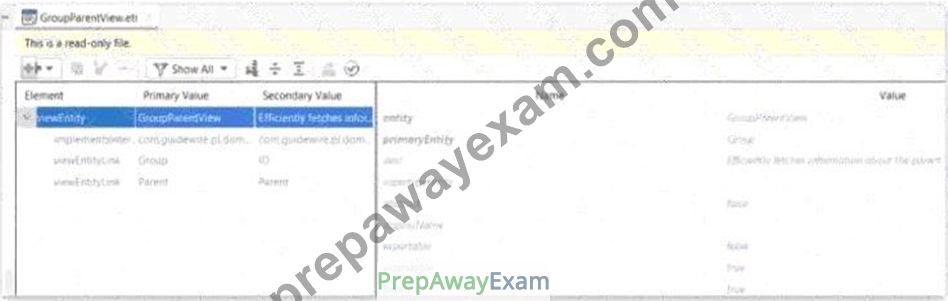
What configuration is needed to add Group.GroupType to a list view using GroupParentView following best practices?
- A. Add a viewEntityType for GroupType to Group Pa rentView.eti
- B. Create a new viewEntity that includes GroupType
- C. Add a viewEntityTypefor GroupType to Group Pa rentView.etx
- D. Set the value on the input widget to GroupParentVlew.Group.GroupType
Answer: C
Explanation:
In Guidewire InsuranceSuite,ViewEntitiesare specialized entities used to optimize the performance of List Views (LVs). Instead of loading full, heavy entity objects into memory (which can cause significant overhead and "N+1 query" issues), a ViewEntity allows the developer to define a "flat" structure that only contains the specific columns needed for display.
1. Extending ViewEntities via .etx (Option C)
When you need to add a field to an existing base ViewEntity, such as GroupParentView, you must follow the standard extension architecture. Since GroupParentView is a base application object, you cannot modify its original definition file (.eti). Instead, you must create or modify an extension file, which has the.etxextension.
Because GroupType is aTypekey(a field linked to a Typelist), the correct metadata tag to use within the ViewEntity definition is<viewEntityType>. This tag maps the typekey from the underlying Group entity to a field on the GroupParentView object. By adding this to the .etx file, you ensure the change is upgrade-safe and follows Guidewire's architectural standards.
2. Performance and Best Practices
Why is Option D considered an anti-pattern? In a PCF List View, if you use the syntax GroupParentView.
Group.GroupType, you are "dot-walking" from the ViewEntity back to the full Group entity. This forces the Guidewire application server to load the entire Group object for every single row in the list. If a list has 100 rows, this could result in 100 unnecessary database loads.
By properly mapping the field in theViewEntity metadata(Option C), the field is included in the initial flattened SQL query generated by the system. This allows the application to retrieve all necessary data for the list in a single, efficient database round-trip. This "Database-First" approach is a core pillar of Guidewire performance tuning and is the primary reason ViewEntities are used in the product.
NEW QUESTION # 27
......
Use Free InsuranceSuite-Developer Exam Questions that Stimulates Actual EXAM : https://itcertspass.prepawayexam.com/Guidewire/braindumps.InsuranceSuite-Developer.ete.file.html